6-Benzylaminopurine, commonly known as 6-BA or BAP, is a synthetic cytokinin plant growth regulator widely used in agriculture, horticulture, plant propagation, and tissue culture. It plays an important role in stimulating cell division, promoting shoot development, delaying leaf senescence, supporting flowering and fruit development, and influencing overall plant growth. Because of its strong physiological activity at relatively low application rates, the development of stable and accurately dosed commercial formulations is essential.
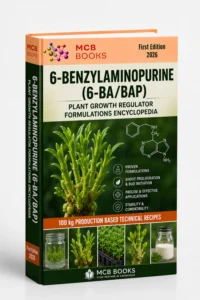
The 6-BENZYLAMINOPURINE (6-BA/BAP) PLANT GROWTH REGULATOR FORMULATIONS ENCYCLOPEDIA provides practical technical information covering formulation design, raw material selection, manufacturing methods, application principles, and commercial production of 6-BA/BAP-based plant growth regulator products. It is designed for manufacturers, formulators, agricultural technicians, researchers, and professionals interested in developing reliable cytokinin-based formulations.
One of the main formulation challenges of 6-benzylaminopurine is its limited solubility in water. For this reason, commercial products may require suitable solvents, co-solvents, solubilizing agents, surfactants, emulsifiers, dispersants, pH regulators, and stabilizers. Correct selection of these materials helps maintain active ingredient uniformity, improve dilution behavior, and prevent crystallization or precipitation during storage.
6-BA/BAP formulations can be produced in different forms depending on the intended agricultural application. These may include soluble concentrates, liquid concentrates, suspension-type formulations, emulsifiable systems, and specialized preparations for plant propagation or tissue culture. Manufacturing generally involves controlled dissolution or dispersion of the active ingredient, incorporation of functional additives, pH adjustment, homogenization, filtration, and final quality control.
In crop production, 6-benzylaminopurine may be used to support shoot formation, lateral branching, cell division, flowering, fruit setting, fruit development, and crop quality. It may also help delay chlorophyll degradation and leaf aging in certain plants, thereby extending physiological activity. The response depends strongly on crop species, application timing, concentration, environmental conditions, and the developmental stage of the plant.
6-BA/BAP is also particularly important in plant tissue culture. Cytokinin-based formulations are commonly incorporated into culture media to stimulate shoot initiation and multiplication. The balance between cytokinins and auxins plays a major role in determining whether plant cells develop into shoots, roots, or undifferentiated tissue.
For commercial production, manufacturers should evaluate important quality parameters such as active ingredient concentration, pH, appearance, density, solubility or dispersibility, dilution stability, storage stability, and compatibility with application water. Accurate dosing is especially important because excessive or inappropriate concentrations may lead to undesirable plant responses.
Professional 6-benzylaminopurine formulation technology combines plant physiology, agricultural chemistry, formulation science, production control, and field application knowledge. Properly designed products can provide stable and uniform delivery of the active ingredient for a wide range of agricultural and horticultural uses. This makes 6-BA/BAP an important component of modern plant growth management and commercial plant growth regulator production.