 Brassinolide is a highly active plant growth regulator belonging to the brassinosteroid family and is widely studied for its effects on plant growth, cell expansion, root development, flowering, fruit formation, crop quality and stress tolerance. Because brassinolide is biologically active at very low concentrations, commercial product development requires accurate formulation design, suitable raw material selection and carefully controlled manufacturing procedures.
The first step in manufacturing brassinolide plant growth regulators is determining the required product type and active ingredient concentration. Depending on the intended agricultural application, brassinolide may be formulated as a soluble concentrate, emulsifiable formulation, suspension system or other water-compatible liquid product. The formulation must be designed according to the solubility characteristics of brassinolide, the target crop, application method and expected storage conditions.
Raw material selection is particularly important because brassinolide has limited direct solubility in water. A commercial formulation may therefore include suitable solvents or co-solvents, surfactants, emulsifiers, wetting agents, dispersing agents, stabilizers, buffering materials, preservatives and carriers. Each component must be compatible with the active ingredient and should contribute to improved solubility, physical stability, spray coverage and application performance.
Commercial manufacturing generally begins with the accurate weighing of all ingredients. The solvent or carrier phase is prepared first in a suitable mixing vessel. Brassinolide is then gradually incorporated under controlled agitation until the active ingredient is completely dissolved or uniformly dispersed. Where necessary, co-solvents or solubilizing agents can be introduced to improve incorporation of the active substance.
After the brassinolide phase has been prepared, surfactants, emulsifiers and other functional additives are added in the required sequence. Controlled mixing helps produce a homogeneous formulation and prevents localized concentration differences. Processing temperature should also be monitored because excessive heat may negatively affect formulation stability or the performance of sensitive ingredients.
pH adjustment is another important manufacturing stage. The finished product should remain within a predetermined pH range suitable for stability and agricultural use. Buffering agents or pH-adjusting materials may therefore be incorporated when necessary. Homogenization is continued until the formulation reaches the desired physical appearance and consistency.
Depending on the product type, filtration may be performed before filling to remove unwanted particles or impurities. Finished brassinolide formulations should then undergo quality-control testing for appearance, pH, density, active ingredient content, solubility, dispersibility, emulsion stability, physical stability and storage behavior. Accelerated stability testing is also useful for estimating commercial shelf life.
Large-scale production requires strict batch control. Mixing speed, ingredient addition order, processing time, temperature and raw material quality should remain consistent from one batch to another. Packaging should also protect the finished formulation from excessive light, heat, moisture and contamination.
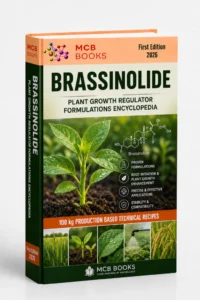
The BRASSINOLIDE PLANT GROWTH REGULATOR FORMULATIONS ENCYCLOPEDIA provides manufacturers, formulators and agricultural professionals with structured information about formulation systems, raw materials, production methods and commercial manufacturing principles. With accurate formulation development and standardized processing, stable and practical brassinolide plant growth regulator products can be produced for professional agricultural applications.