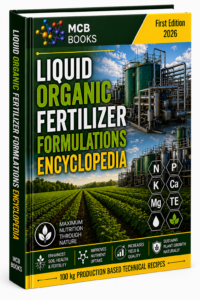
 Microbial and bacterial fertilizers are becoming increasingly important in modern agriculture because they can support soil fertility, root development, nutrient availability, and overall crop performance. These products contain beneficial microorganisms that may contribute to biological processes in the soil and root zone. The MICROBIAL & BACTERIAL FERTILIZER FORMULATIONS ENCYCLOPEDIA is designed as a practical technical resource for fertilizer manufacturers, formulators, agricultural companies, researchers, and entrepreneurs interested in professional microbial biofertilizer production.
Microbial biofertilizer formulations may contain selected beneficial bacteria, microbial cultures, suitable carrier materials, nutrient sources, stabilizers, protective agents, preservatives compatible with living microorganisms, and water or other appropriate liquid media. Depending on the intended agricultural application, products can be developed for soil treatment, seed treatment, root-zone application, fertigation, and other professional crop nutrition programs.
Different groups of beneficial microorganisms can be used in microbial fertilizer production. Nitrogen-fixing bacteria, phosphate-solubilizing bacteria, potassium-mobilizing microorganisms, and plant growth-promoting rhizobacteria are among the organisms commonly studied and used in agricultural biofertilizer technologies. Each microbial strain has specific biological characteristics, environmental requirements, and compatibility considerations that should be evaluated before formulation.
The production of microbial and bacterial fertilizers requires careful control because the microorganisms must remain viable during manufacturing, storage, transportation, and application. Important factors may include culture purity, microbial concentration, pH, temperature, oxygen availability, nutrient composition, moisture, carrier selection, and storage conditions. Production methods may involve controlled fermentation followed by formulation, stabilization, quality control, and packaging.
Liquid microbial fertilizers require particular attention to formulation stability and microorganism survival. The liquid carrier should be compatible with the selected microbial strain and should not contain ingredients that negatively affect microbial viability. Solid or carrier-based formulations may use suitable materials that help protect microorganisms and maintain an acceptable viable cell population during storage.
Quality control is essential in commercial microbial biofertilizer manufacturing. Important parameters may include microbial identity, viable cell count, contamination level, pH, appearance, physical stability, storage stability, and packaging compatibility. Manufacturers should also establish appropriate shelf-life specifications and storage recommendations according to the characteristics of each microbial product.
The MICROBIAL & BACTERIAL FERTILIZER FORMULATIONS ENCYCLOPEDIA provides practical information about microbial biofertilizer formulations, beneficial bacterial strains, raw materials, fermentation methods, production procedures, stabilization, quality control, and commercial product development. It is a comprehensive technical reference for professionals seeking practical knowledge about bacterial fertilizers, beneficial microorganisms, soil microbial products, and modern commercial biofertilizer production.