Liquid organic fertilizers are widely used in modern agriculture because they can be applied through foliar spraying, fertigation, and direct soil application. Their flexible application methods make them suitable for vegetables, fruits, cereals, greenhouse crops, ornamentals, and many other professional agricultural systems. Depending on the formulation, liquid organic fertilizers can support plant nutrition, root development, nutrient uptake, soil fertility, vegetative growth, flowering, fruit development, and overall crop performance.
Liquid organic fertilizer formulations may contain humic acid, fulvic acid, amino acids, protein hydrolysates, seaweed extracts, organic nitrogen sources, potassium compounds, micronutrients, organic acids, stabilizers, preservatives, and water. The exact composition should be selected according to the intended application method, crop requirements, product concentration, and desired technical properties. Solubility, pH, viscosity, and raw material compatibility are especially important when developing products for different agricultural application systems.
Foliar liquid organic fertilizers are designed for application directly to plant leaves. These formulations should provide good solubility, low sediment formation, appropriate pH, and suitable spreading characteristics. Amino acids, fulvic acid, seaweed extracts, potassium, and micronutrients may be combined to create multifunctional foliar products for plant growth and nutrient management. Wetting agents or compatible surfactants may also be included when required to improve coverage on plant surfaces.
Fertigation products are delivered through irrigation systems and therefore require high solubility and reliable stability. Excessive sediment or precipitation can interfere with irrigation equipment, so raw material compatibility must be carefully evaluated. Fulvic acid, amino acids, soluble humic substances, seaweed extracts, potassium compounds, and micronutrients can be incorporated into fertigation formulations depending on the intended crop nutrition program.
Soil application is another major use of liquid organic fertilizers. Products containing humic acid, potassium humate, fulvic acid, amino acids, and seaweed extracts can be applied directly to the soil or root zone. These formulations may be designed to support soil conditioning, nutrient availability, root development, and overall plant establishment.
Commercial manufacturing requires careful control of mixing order, temperature, pH, density, viscosity, solubility, filtration, and storage stability. Finished products should be evaluated for appearance, nutrient content, organic matter, sediment formation, and packaging compatibility before commercial distribution.
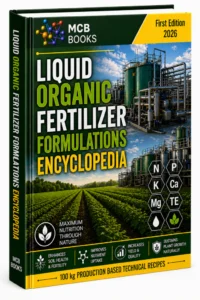
The LIQUID ORGANIC FERTILIZER FORMULATIONS ENCYCLOPEDIA provides practical technical information about foliar organic fertilizers, fertigation formulations, soil-applied liquid fertilizers, raw materials, production methods, manufacturing procedures, and quality control. It is designed for fertilizer manufacturers, formulators, agricultural companies, and entrepreneurs seeking to develop professional liquid organic fertilizers for modern crop nutrition and commercial agricultural production.