 Liquid organic fertilizer production requires careful control of mixing, pH adjustment, filtration, product stability, quality control, and packaging. These stages are essential for manufacturing consistent and commercially viable fertilizers for foliar spraying, fertigation, soil application, and root-zone treatment. For professional fertilizer manufacturers, establishing a controlled production process helps improve batch consistency, product appearance, storage performance, and compatibility with agricultural application systems.
The production process generally begins with the preparation of water or another suitable liquid carrier in a mixing vessel. Raw materials such as humic acid, fulvic acid, amino acids, protein hydrolysates, seaweed extracts, organic nitrogen sources, potassium compounds, micronutrients, and other functional ingredients are then added according to the formulation. The order of addition is especially important because incompatible ingredients may cause precipitation, sediment formation, excessive viscosity, or phase separation.
Mixing conditions should be carefully controlled throughout liquid organic fertilizer manufacturing. Agitation speed, processing time, temperature, and raw material addition rate can influence dissolution and product uniformity. Some ingredients require gradual addition to prevent agglomeration, while others may need sufficient mixing time to achieve complete dispersion. Manufacturers should avoid unnecessary high temperatures when working with heat-sensitive organic components.
pH control is another critical stage in the production process. The pH of a liquid organic fertilizer can influence nutrient solubility, humic substance behavior, micronutrient compatibility, preservative effectiveness, and long-term stability. Appropriate pH-adjusting materials may be used when necessary, but adjustments should be made gradually while continuously monitoring the formulation.
Filtration can help remove insoluble particles and improve the appearance and application performance of the finished fertilizer. This is particularly important for fertigation and foliar products, where sediment or suspended particles may interfere with irrigation equipment or spray nozzles. The required filtration level depends on the raw materials, product type, and intended application.
Stability testing is essential before commercial distribution. Finished products should be evaluated for appearance, pH, density, viscosity, solubility, sediment formation, phase separation, nutrient content, organic matter, and storage behavior. Temperature variations during storage should also be considered because they can influence viscosity, crystallization, and product stability.
Packaging is the final stage of liquid organic fertilizer production. Containers should be chemically compatible with the formulation and provide adequate protection during storage, transportation, and distribution. Proper labeling, batch identification, and storage instructions are also important for commercial fertilizer products.
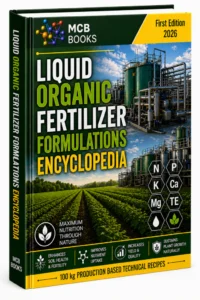
The LIQUID ORGANIC FERTILIZER FORMULATIONS ENCYCLOPEDIA provides practical technical information about liquid organic fertilizer production methods, mixing procedures, pH control, filtration, stability testing, packaging, raw materials, and quality control. It is designed for fertilizer manufacturers, formulators, agricultural companies, and entrepreneurs seeking professional knowledge for commercial liquid organic fertilizer manufacturing.