Humic acid and organic matter based granular fertilizers are increasingly used in modern agriculture because they combine plant nutrition with soil improvement. These fertilizers are designed to provide essential nutrients while also supporting soil structure, nutrient retention, root development, and long-term soil fertility. For fertilizer manufacturers, developing stable and effective granular formulations requires careful selection of organic materials, humic substances, mineral nutrients, and processing aids.
Humic acid is one of the most widely used components in organomineral fertilizer formulations. It is generally obtained from humified organic materials such as leonardite and other naturally occurring organic deposits. Humic substances can contribute to improved nutrient availability, cation exchange capacity, and root-zone conditions. When incorporated into granular fertilizers, humic acid can help create products that combine the benefits of organic matter with the efficiency of mineral plant nutrients.
Organic matter is also an important component of granular fertilizer formulations. Depending on the product concept, manufacturers may use processed plant materials, compost-derived ingredients, lignite-based organic materials, or other suitable organic sources. These materials can help improve soil aggregation, water-holding capacity, and nutrient retention while contributing organic carbon to the soil.
Humic acid and organic matter based granular fertilizers can be combined with nitrogen, phosphorus, and potassium to develop complete organomineral NPK products. Nitrogen supports vegetative growth, phosphorus is important for root development and energy transfer, and potassium contributes to water regulation, stress tolerance, and crop quality. The proportions of these nutrients should be selected according to crop requirements and the intended agricultural application.
Secondary nutrients such as calcium, magnesium, and sulfur may also be included. In addition, micronutrients including iron, zinc, manganese, copper, boron, and molybdenum can be incorporated to create more complete plant nutrition products. This allows manufacturers to formulate granular fertilizers for specific crops, soil conditions, and growth stages.
The manufacturing process generally begins with accurate weighing and homogeneous mixing of the selected raw materials. The blended material is then prepared for granulation. Moisture, binders, or suitable granulation aids may be used to promote particle formation and produce granules with adequate mechanical strength. After granulation, the product is dried and cooled to achieve the desired moisture level and storage stability.
Screening is then used to separate acceptable granules from oversized and undersized particles. Off-size material can often be recycled back into the manufacturing process. Depending on the formulation, coating or anti-caking materials may also be applied to improve flowability, reduce dust, and prevent granules from sticking together during storage and transportation.
Quality control is essential in commercial production. Important parameters can include organic matter content, humic acid concentration, NPK values, micronutrient content, moisture level, particle size distribution, bulk density, granule strength, pH, and storage stability. Consistent testing helps manufacturers produce fertilizers that meet the desired technical specifications.
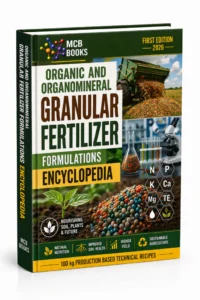
The ORGANIC AND ORGANOMINERAL GRANULAR FERTILIZER FORMULATIONS ENCYCLOPEDIA provides practical information for professionals developing humic acid and organic matter based fertilizer products. It covers formulation concepts, raw material functions, production methods, and commercial manufacturing principles for granular fertilizer production.
For fertilizer manufacturers, agricultural companies, entrepreneurs, and formulation specialists, the ORGANIC AND ORGANOMINERAL GRANULAR FERTILIZER FORMULATIONS ENCYCLOPEDIA can serve as a valuable reference for developing granular fertilizers that support soil fertility, balanced plant nutrition, root development, and sustainable agricultural productivity.