 Crop-specific organic and organomineral granular fertilizer formulations are developed to meet the different nutritional requirements of plants throughout their growth cycle. Instead of using a single fertilizer composition for every crop, manufacturers can design specialized products with different ratios of nitrogen, phosphorus, potassium, organic matter, humic substances, secondary nutrients, and micronutrients. This approach can support more efficient plant nutrition, higher crop yield, and improved crop quality.
Every crop has different nutritional needs depending on its growth characteristics, soil conditions, climate, and production system. Cereals, vegetables, fruit trees, vineyards, greenhouse crops, and industrial crops may require different nutrient balances. A fertilizer designed for rapid vegetative development may contain a different nutrient profile from a product intended for flowering, fruit formation, or final crop maturation.
Nitrogen is one of the most important nutrients for vegetative growth, leaf development, chlorophyll production, and protein synthesis. Crops with high biomass requirements may need formulations with increased nitrogen levels during active growth stages. However, excessive nitrogen can cause unbalanced vegetative growth and may reduce flowering or fruit quality. Crop-specific fertilizer formulations therefore require carefully balanced nitrogen concentrations.
Phosphorus plays an important role in root development, early plant establishment, energy transfer, flowering, and reproductive growth. Fertilizers developed for transplant establishment, young plants, or crops requiring strong root systems can contain phosphorus at levels appropriate to the target application. Efficient phosphorus nutrition can help plants develop stronger root systems and improve nutrient uptake.
Potassium is particularly important for water regulation, enzyme activity, stress tolerance, fruit development, and crop quality. Fruit trees, vegetables, vineyards, and other high-value crops may require increased potassium during flowering, fruit enlargement, and maturation. Balanced potassium nutrition can contribute to fruit size, firmness, quality, and overall marketability.
Organic matter and humic substances are valuable components of crop-specific organomineral granular fertilizers. They can be combined with mineral nutrients to support soil fertility, nutrient retention, and root-zone conditions. This allows manufacturers to create products that provide both immediate mineral nutrition and additional organic components within the same granular formulation.
Secondary nutrients such as calcium, magnesium, and sulfur can also be incorporated according to crop requirements. Calcium may be important for fruit quality and plant tissue development, magnesium supports chlorophyll formation, and sulfur is involved in protein synthesis and enzyme activity.
Micronutrients including iron, zinc, manganese, boron, copper, and molybdenum may be added to specialized formulations. The required micronutrient profile can vary considerably among crops. Boron and zinc, for example, may be important in certain flowering and fruiting programs, while iron and manganese may be included in formulations intended for crops grown in soils where micronutrient availability is limited.
Commercial crop-specific fertilizer production requires accurate formulation, homogeneous mixing, controlled granulation, drying, cooling, screening, and quality control. Manufacturers must also consider raw material compatibility, granule strength, moisture stability, nutrient distribution, particle size, and storage performance.
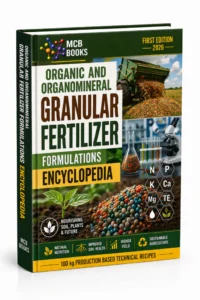
The ORGANIC AND ORGANOMINERAL GRANULAR FERTILIZER FORMULATIONS ENCYCLOPEDIA provides practical information for professionals interested in developing crop-specific fertilizer products. It includes production-based formulation concepts, raw material functions, manufacturing methods, and technical principles related to commercial organic and organomineral granular fertilizer production.
For fertilizer manufacturers, agricultural companies, formulation specialists, and entrepreneurs, the ORGANIC AND ORGANOMINERAL GRANULAR FERTILIZER FORMULATIONS ENCYCLOPEDIA can serve as a valuable reference for developing fertilizers tailored to different crops and growth stages. Crop-specific formulations can help manufacturers build a more diversified product range while supporting balanced plant nutrition, higher agricultural productivity, and improved crop quality.