The increasing demand for sustainable greenhouse farming has created new opportunities for companies interested in commercial greenhouse biopesticide production. Greenhouse crops are highly productive, but their controlled growing conditions can also encourage the rapid development of insects, mites, fungal diseases, nematodes, and soil-borne pathogens. For this reason, manufacturers need well-designed biological crop protection products that combine suitable active materials with stable formulation systems, reliable production methods, and practical agricultural application characteristics.
The first stage in manufacturing greenhouse biopesticides is determining the target problem and selecting the appropriate biological control strategy. Products may be developed for greenhouse pests such as whiteflies, aphids, thrips, spider mites, caterpillars, and mealybugs, as well as for fungal diseases including Botrytis, downy mildew, Alternaria, leaf spot diseases, and root rot. Separate biological formulations may also be designed for nematode suppression, soil-borne pathogen management, and root-zone protection.
After selecting the biological active component, the next step is formulation development. A commercial greenhouse biopesticide generally requires more than the active ingredient alone. Depending on the product type, manufacturers may use carriers, fillers, stabilizers, wetting agents, dispersing agents, suspending agents, protective materials, anti-caking agents, rheology modifiers, and other compatible formulation ingredients. These materials are selected to improve stability, handling, dilution, storage, and application performance.
Greenhouse biopesticides can be manufactured in different forms, including liquid concentrates, suspension formulations, wettable powders, dispersible powders, granules, and products designed for drip irrigation or root-zone application. The correct formulation form depends on the target crop, pest or disease, biological active material, agricultural equipment, and intended application method.
The manufacturing process may include raw material preparation, controlled mixing, dispersion, homogenization, stabilization, filtration where required, filling, and packaging. Biological formulations can be sensitive to unsuitable temperature, pH, moisture, oxygen exposure, and excessive mechanical stress. Therefore, production parameters must be carefully controlled to protect the activity and stability of the final product.
Quality control is essential in professional greenhouse biopesticide manufacturing. Depending on the formulation, manufacturers may evaluate pH, viscosity, moisture content, particle size, suspension stability, dispersibility, microbial viability, biological activity, contamination levels, storage stability, and packaging compatibility. Consistent batch quality is especially important for products intended for commercial greenhouse operations.
Packaging and storage conditions should also be selected according to the sensitivity of the formulation. Containers may need to provide protection against excessive heat, moisture, light, or oxygen. Stability testing helps establish appropriate storage recommendations and shelf-life specifications.
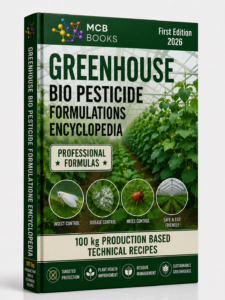
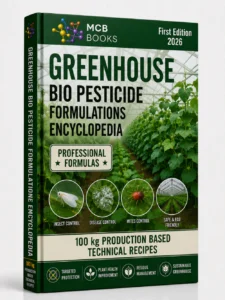
The GREENHOUSE BIO PESTICIDE FORMULATIONS ENCYCLOPEDIA provides practical technical information for companies planning to manufacture biological crop protection products for protected agriculture. It covers formulation concepts, raw material functions, industrial production methods, application principles, and technical product characteristics. For biopesticide manufacturers, agricultural input companies, R&D specialists, formulation developers, entrepreneurs, and investors, it offers a useful foundation for developing professional greenhouse bioinsecticides, biofungicides, bionematicides, root-zone products, and other commercially applicable biological crop protection formulations.