Daminozide is a plant growth regulator widely associated with controlling excessive vegetative development and producing shorter, more compact, and commercially desirable plants. For professional manufacturers, developing 100 kg daminozide plant growth regulator formulas requires careful consideration of active ingredient concentration, formulation stability, raw material compatibility, application properties, storage conditions, and the specific crop or horticultural production program for which the finished product is intended.
A typical 100 kg commercial formulation is designed around daminozide as the principal active ingredient together with an appropriate carrier system and supporting formulation auxiliaries. Depending on the required product type, these may include purified or deionized water, wetting agents, dispersing agents, buffering materials, chelating agents, stabilizers, preservatives, antifoaming agents, humectants, and other functional components. The quantity and combination of these materials must be selected so that the final batch reaches exactly 100 kg while maintaining acceptable physical and chemical stability.
Different daminozide formulations can be designed for different plant-growth-management objectives. Height-control formulations are intended to reduce excessive shoot elongation and help maintain a more manageable plant structure. Compact-growth formulations focus on shorter internodes, improved plant uniformity, and a denser appearance, particularly in ornamental and nursery production. Formulation design may also support programs associated with flowering management, uniform crop development, and improvements in overall market quality where such uses are permitted.
For fruit and crop production, daminozide programs require particularly careful consideration of local regulations and approved crop uses. Plant response depends on crop species, cultivar, growth stage, environmental conditions, concentration, and application timing. Manufacturers therefore need to develop products that provide consistent dilution behavior and predictable application characteristics while ensuring that all label claims remain within the registration requirements of the target market.
Commercial production of a 100 kg batch normally begins with the preparation of the carrier phase. Water-soluble auxiliaries are incorporated under controlled agitation, followed by the daminozide active ingredient and remaining functional additives. Mixing continues until a homogeneous product is obtained. The batch may subsequently undergo pH adjustment, final weight correction, filtration, and quality-control testing before packaging.
Important quality parameters include active ingredient content, appearance, pH, density, solubility or dispersibility, dilution stability, physical stability, storage stability, and packaging compatibility. Consistency between production batches is especially important for commercial plant growth regulator products.
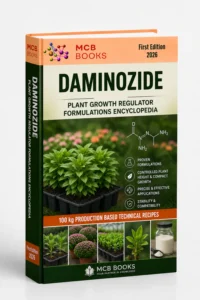
The DAMINOZIDE PLANT GROWTH REGULATOR FORMULATIONS ENCYCLOPEDIA provides practical technical guidance for developing 100 kg formulations for height control, compact growth, flowering management, plant development, and crop-quality applications. It also covers raw-material selection, production procedures, formulation principles, application considerations, and commercial manufacturing methods, making it a useful reference for agrochemical manufacturers, horticultural product developers, formulation specialists, and professional agricultural producers.
All commercial daminozide products must be manufactured, registered, labeled, and used according to the regulations and approved crop applications of the country in which they are marketed.