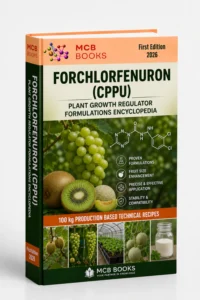
Forchlorfenuron, commonly known as CPPU, is a synthetic plant growth regulator widely studied and used in commercial agriculture for improving fruit development, fruit size, cell division, fruit set, and overall crop quality. Because CPPU is highly active at relatively low application levels, the preparation of stable and effective agricultural formulations requires careful selection of solvents, surfactants, dispersing agents, stabilizers, preservatives, and other formulation components. The FORCHLORFENURON (CPPU) PLANT GROWTH REGULATOR FORMULATIONS ENCYCLOPEDIA provides practical technical information for professionals interested in CPPU formulation, production, application, and commercial manufacturing.
Commercial CPPU products may be developed in several formulation types depending on the intended agricultural use and required concentration. These can include soluble concentrates, suspension concentrates, emulsifiable or solvent-based concentrates, water-dispersible systems, and other specialized agricultural formulations. The formulation system must keep the active ingredient stable during manufacturing, storage, transportation, dilution, and field application.
Raw material selection is one of the most important stages in CPPU plant growth regulator production. In addition to Forchlorfenuron as the active ingredient, formulations may contain suitable solvents or carriers, nonionic surfactants, wetting agents, dispersing agents, emulsifiers, rheology modifiers, antifoaming agents, preservatives, buffers, and stabilizers. Each material performs a specific technical function and contributes to the physical stability and application performance of the final product.
The manufacturing process generally involves accurate weighing of raw materials, preparation of the liquid or carrier phase, controlled incorporation of CPPU, addition of surfactants and stabilizing materials, homogenization, pH adjustment where required, filtration or particle-size control, and final quality testing. Proper mixing conditions are especially important because poor dispersion or incomplete dissolution can cause sedimentation, crystallization, inconsistent active ingredient concentration, or reduced field performance.
Forchlorfenuron is particularly associated with applications designed to support cell division and fruit enlargement. Depending on the crop and local regulatory approvals, CPPU-based plant growth regulators may be used in production programs involving grapes, kiwifruit, melons, berries, and various other fruit crops. Application timing, concentration, climatic conditions, crop variety, and growth stage are critical factors because plant growth regulators can produce different responses when applied at different developmental periods.
Industrial production also requires systematic quality control. Typical parameters can include appearance, active ingredient concentration, pH, density, viscosity, dispersion or solubility behavior, storage stability, low- and high-temperature stability, and dilution characteristics. Packaging compatibility should also be evaluated before commercial distribution.
The FORCHLORFENURON (CPPU) PLANT GROWTH REGULATOR FORMULATIONS ENCYCLOPEDIA is designed as a technical resource covering formulation principles, raw material functions, manufacturing methods, production processes, application concepts, and commercial-scale considerations. It can serve as a practical reference for agricultural chemical manufacturers, formulation specialists, researchers, technical consultants, and companies developing specialized plant growth regulator products for professional agriculture.