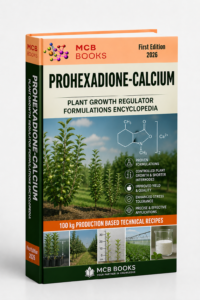
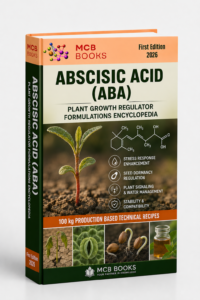
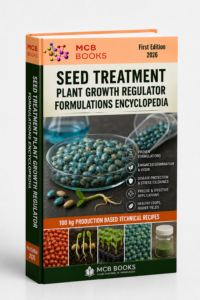
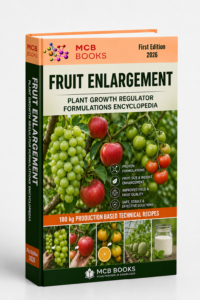
Daminozide is a well-known plant growth regulator used in professional horticulture and ornamental plant production to control excessive vegetative growth, improve plant compactness, strengthen stems, and support more uniform crop development. Commercial daminozide products require carefully designed formulations that provide good solubility, stability, compatibility, storage performance, and reliable application characteristics. For manufacturers, formulators, agricultural professionals, and technical researchers, understanding both the active ingredient and the complete formulation system is essential for producing consistent and effective plant growth regulator products.
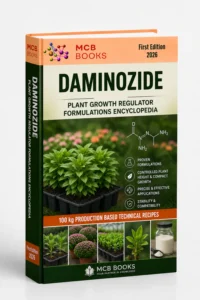
The DAMINOZIDE PLANT GROWTH REGULATOR FORMULATIONS ENCYCLOPEDIA provides practical technical information covering daminozide formulations, raw materials, production processes, application principles, and commercial manufacturing considerations. The encyclopedia is designed to help professionals understand how different formulation components work together and how daminozide-based products can be prepared for agricultural and horticultural use.
A commercial daminozide formulation may contain the active ingredient together with water, carriers, wetting agents, dispersing agents, stabilizers, buffering materials, preservatives, antifoaming agents, chelating agents, and other formulation auxiliaries. The exact composition depends on the intended product form, active ingredient concentration, application method, storage requirements, and target market. Correct selection of these materials is important because formulation quality directly affects product stability, dilution behavior, plant coverage, and field performance.
Manufacturing normally involves controlled charging of the liquid phase, dissolution or dispersion of functional additives, incorporation of daminozide, pH adjustment, homogenization, filtration where necessary, and final quality control. Parameters such as mixing speed, processing temperature, pH, water quality, ingredient addition sequence, and final viscosity should be monitored carefully during production. Industrial manufacturers must also confirm active ingredient content, physical stability, appearance, density, pH, storage stability, and packaging compatibility before commercial release.
Daminozide is primarily used where excessive shoot elongation must be reduced and a more compact plant structure is desired. Depending on the crop and approved local use pattern, it may be associated with improved stem strength, controlled internode length, uniform canopy development, flowering management, and improved ornamental quality. Application concentration and timing are especially important because plant response can vary significantly according to species, cultivar, environmental conditions, growth stage, and production system.
Commercial production of daminozide plant growth regulators also requires careful attention to regulatory compliance. Registration requirements, permitted crops, application rates, residue restrictions, labeling rules, worker protection standards, and environmental regulations differ between countries and must always be checked before manufacturing or marketing a product.
The DAMINOZIDE PLANT GROWTH REGULATOR FORMULATIONS ENCYCLOPEDIA brings formulation technology, manufacturing knowledge, application information, and commercial production principles together in one technical reference. It is therefore a valuable resource for agricultural chemical manufacturers, formulation specialists, plant growth regulator producers, horticultural professionals, technical consultants, and companies developing specialized plant growth management products.