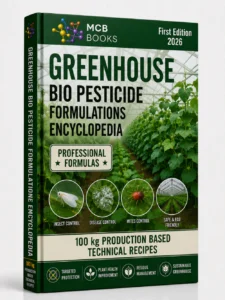
 Professional greenhouse agriculture requires reliable crop protection products capable of addressing insects, fungal diseases, and soil-borne pathogens under intensive production conditions. For manufacturers developing biological crop protection solutions, 100 kg greenhouse biopesticide formulas provide a practical production basis for standardizing raw material quantities, organizing manufacturing processes, and scaling formulations for commercial use. The GREENHOUSE BIO PESTICIDE FORMULATIONS ENCYCLOPEDIA is designed as a technical resource for companies and professionals interested in developing greenhouse-specific biological pesticide products.
Greenhouse crops such as tomato, pepper, cucumber, eggplant, strawberry, lettuce, leafy vegetables, and ornamentals may be affected by pests including whiteflies, aphids, thrips, spider mites, caterpillars, and mealybugs. Biological insect-control products can be formulated to support integrated pest management programs and provide alternative crop protection strategies. A professional formulation may contain biological active materials together with suitable carriers, wetting agents, dispersing agents, stabilizers, suspending agents, protective materials, and other formulation components selected according to the intended application.
Fungal diseases are another important challenge in greenhouse production. Conditions such as high humidity, warm temperatures, dense crop canopies, and restricted air circulation may support diseases including Botrytis, Alternaria, downy mildew, leaf spot diseases, seedling diseases, and root rot. Greenhouse biofungicide formulations must therefore be designed to provide suitable stability, coverage, dispersion, and compatibility with the selected biological control system.
Soil-borne pathogens and root-zone problems can also significantly reduce greenhouse crop performance. Biological formulations may be developed for root rot management, soil pathogen suppression, nematode management, growing-media treatment, hydroponic systems, and drip irrigation applications. These products require particular attention to compatibility, water dispersibility, particle size, suspension characteristics, and application through irrigation equipment.
Using a 100 kg production formula provides manufacturers with a convenient reference for professional batch preparation. Raw materials can be calculated directly in kilograms per 100 kg of final product, simplifying production planning and allowing validated formulations to be scaled proportionally for larger industrial batches. However, successful manufacturing depends not only on ingredient ratios but also on correct mixing order, processing conditions, homogenization, stabilization, and packaging.
Quality control is essential for every commercial batch. Depending on the formulation, manufacturers may evaluate pH, viscosity, moisture content, dispersibility, suspension stability, particle size, biological activity, microbial viability, contamination control, and storage stability. Packaging should also protect sensitive biological components from excessive heat, humidity, oxygen, or light where necessary.
The GREENHOUSE BIO PESTICIDE FORMULATIONS ENCYCLOPEDIA provides practical information on formulation principles, raw material functions, industrial production methods, technical characteristics, and application concepts for greenhouse crop protection. It is particularly useful for biopesticide manufacturers, agricultural input companies, formulation specialists, R&D departments, entrepreneurs, and investors seeking to develop commercial products for insect pests, fungal diseases, soil-borne pathogens, and root-zone protection.
By combining standardized 100 kg greenhouse biopesticide formulas with professional manufacturing knowledge, producers can build a stronger technical foundation for developing stable, practical, and commercially applicable biological crop protection products.