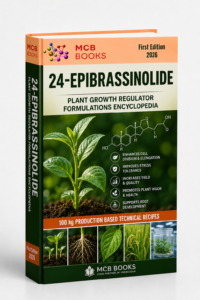
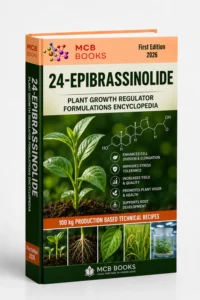
 24-Epibrassinolide is an important brassinosteroid plant growth regulator used in professional agriculture to support plant development, improve tolerance to environmental stresses, promote flowering and fruit development, and contribute to improved crop productivity. Because it is biologically active at very low concentrations, commercial 24-epibrassinolide products require carefully designed formulations that provide accurate dosing, stability, uniform distribution, and reliable performance under field conditions.
Developing 100 kg 24-epibrassinolide plant growth regulator formulas begins with defining the intended agricultural application and the concentration of the finished product. Formulations designed primarily for vegetative growth may differ from products developed for flowering, fruit development, stress management, or general crop productivity. The active ingredient level, carrier system, surfactant package, and supporting formulation ingredients must therefore be selected according to the desired product characteristics.
A typical commercial formulation may contain 24-epibrassinolide as the active component together with suitable solvents or co-solvents, emulsifiers, wetting agents, dispersing agents, stabilizers, preservatives, pH-adjusting materials, antifoaming agents, and purified water. Since 24-epibrassinolide has limited direct water solubility, the correct solubilization or dispersion system is especially important for manufacturing stable liquid products.
Formulations intended to promote plant growth are generally designed to provide uniform distribution of very small amounts of active ingredient over plant surfaces. These products may support cell development, vegetative growth, root activity, and overall plant vigor when applied according to crop-specific recommendations.
For stress-tolerance applications, 24-epibrassinolide formulations may be incorporated into crop-management programs targeting drought, salinity, temperature stress, transplant shock, or other unfavorable environmental conditions. Proper formulation helps ensure consistent delivery of the active ingredient while maintaining compatibility with agricultural application systems.
Flowering and fruit-development formulations are developed to support physiological processes associated with reproductive growth. Depending on the crop and application stage, 24-epibrassinolide may be used as part of programs intended to improve flowering performance, fruit formation, fruit development, crop uniformity, and final market quality.
In commercial 100 kg production, manufacturing normally begins with preparation of the solvent or carrier phase. The active ingredient is incorporated under controlled agitation, followed by surfactants, stabilizers, and other functional raw materials. The aqueous phase, when required, is then introduced gradually while maintaining continuous mixing. Final operations may include pH adjustment, homogenization, filtration, quality control, and packaging.
Finished products should be evaluated for parameters such as active ingredient content, appearance, pH, density, solubility or dispersibility, dilution stability, sedimentation, storage stability, and compatibility with application water. Because plant growth regulators can produce different physiological responses depending on concentration and crop stage, formulation accuracy and correct application dosage are critical.
Well-designed 100 kg 24-epibrassinolide formulations provide manufacturers with a practical basis for producing professional plant growth regulator products for plant growth, stress tolerance, flowering, fruit development, and crop-yield applications. Combining appropriate raw materials, controlled manufacturing techniques, and rigorous quality testing is essential for achieving stable, uniform, and commercially viable agricultural formulations.