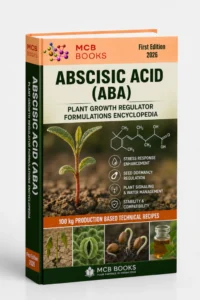
 Abscisic acid (ABA) is one of the most important plant growth regulators involved in the control of plant development, water balance, seed dormancy, stomatal movement, stress responses and crop adaptation to unfavorable environmental conditions. Because of its central role in plant physiology, ABA-based agricultural products are increasingly studied for use in professional crop production, horticulture, greenhouse cultivation and specialty plant management. The ABSCISIC ACID (ABA) PLANT GROWTH REGULATOR FORMULATIONS ENCYCLOPEDIA provides practical technical information for understanding ABA formulations, production methods, raw materials, application systems and commercial manufacturing principles.
The effectiveness of an ABA plant growth regulator depends not only on the concentration of the active ingredient but also on the formulation system used to deliver it to the plant. Commercial ABA products may be developed as soluble concentrates, suspension systems, emulsifiable formulations, water-dispersible products or other application-specific forms. The selection of solvents, surfactants, wetting agents, stabilizers, buffers, preservatives and carriers can significantly influence solubility, storage stability, spray coverage and biological performance.
One of the major agricultural functions of abscisic acid is the regulation of stomatal closure during water stress. When plants experience drought or other environmental stresses, ABA signaling can help reduce excessive water loss through transpiration. ABA is also closely associated with seed maturation and dormancy, enabling plants to regulate germination according to environmental conditions. In certain crops, carefully managed ABA applications may also influence fruit coloration, maturation, quality characteristics and physiological responses during production.
Commercial manufacturing of ABA plant growth regulator products requires accurate formulation design and controlled processing. Raw materials must be selected according to their compatibility with the active ingredient and the intended application method. Manufacturing generally includes accurate weighing of ingredients, preparation of the solvent or carrier phase, controlled incorporation of ABA, addition of functional additives, pH adjustment, homogenization, filtration where required and final quality control before packaging.
Product stability is an especially important consideration. Factors such as pH, temperature, light exposure, water quality and interaction with formulation ingredients can affect the chemical and physical stability of the finished product. For this reason, laboratory stability studies and compatibility evaluations are essential before commercial-scale production.
ABA formulations can be designed for different crops and application objectives, including drought stress management, water-use regulation, dormancy control, fruit development and crop quality improvement. Application concentration, timing, crop growth stage and environmental conditions must always be carefully considered to achieve consistent results.
The ABSCISIC ACID (ABA) PLANT GROWTH REGULATOR FORMULATIONS ENCYCLOPEDIA: COMPLETE GUIDE TO ABA FORMULATIONS, APPLICATIONS AND COMMERCIAL PRODUCTION is intended as a practical technical reference for manufacturers, formulators, agricultural professionals, researchers and entrepreneurs interested in the development and production of ABA-based plant growth regulator products. By combining formulation principles, manufacturing knowledge and agricultural application concepts, the encyclopedia offers a structured resource for professional and commercial ABA product development.