Paclobutrazol is an important plant growth regulator widely used in modern agriculture, horticulture, fruit production and ornamental crop management. It belongs to the triazole group of plant growth regulators and is primarily known for its ability to reduce excessive vegetative growth by inhibiting gibberellin biosynthesis. Through proper use, Paclobutrazol can help control plant height, shorten internodes, promote compact growth and support more balanced vegetative and reproductive development.
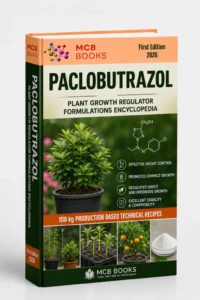
The PACLOBUTRAZOL PLANT GROWTH REGULATOR FORMULATIONS ENCYCLOPEDIA is designed as a comprehensive technical reference for manufacturers, formulators, agricultural professionals, researchers and companies interested in developing commercial Paclobutrazol-based products. It covers important topics related to formulation technology, raw materials, manufacturing principles, quality control and practical agricultural applications.
Paclobutrazol can be formulated in several commercial forms depending on the intended application and market requirements. Common formulation types may include suspension concentrates, emulsifiable concentrates, soluble or dispersible liquid systems and other specialized agricultural formulations. Because the physicochemical characteristics of Paclobutrazol influence its behavior in water and formulation media, suitable solvents, surfactants, dispersing agents, wetting agents and stabilizers must be selected carefully.
Commercial manufacturing begins with defining the required active ingredient concentration and final formulation type. In liquid or suspension systems, the carrier phase is prepared first, followed by the gradual incorporation of functional additives and the active ingredient. High-shear mixing, homogenization or milling may be required for suspension-based products to achieve a suitable particle size and stable dispersion. Process variables such as mixing speed, temperature, pH and order of addition should be carefully controlled.
Paclobutrazol is particularly useful where excessive vegetative growth needs to be managed. It can reduce stem elongation and internode length, resulting in shorter and more compact plants. In some crop systems, controlling vegetative growth may help improve canopy structure, light distribution and crop management efficiency. It may also support flowering and reproductive development when applied correctly according to crop requirements.
The effectiveness of Paclobutrazol depends strongly on dosage, timing, crop species, plant growth stage, environmental conditions and method of application. For this reason, commercial products should be supported by clearly defined application instructions and used in accordance with applicable agricultural regulations.
Quality control is an essential part of production. Typical evaluations may include active ingredient content, appearance, pH, density, viscosity, particle size, suspensibility, emulsion stability, homogeneity and storage stability. Packaging materials should also be chemically compatible with the formulation and provide adequate protection during transportation and storage.
The PACLOBUTRAZOL PLANT GROWTH REGULATOR FORMULATIONS ENCYCLOPEDIA provides manufacturers and agricultural professionals with practical information for developing reliable Paclobutrazol products. By combining formulation knowledge, controlled manufacturing processes and appropriate application strategies, Paclobutrazol-based plant growth regulators can be effectively used for height control, compact growth, flowering management and improved crop production.