Trinexapac-Ethyl is an important plant growth regulator used in modern agriculture, cereal production, turf management and professional crop cultivation. It is mainly used to reduce excessive stem elongation, shorten internodes, strengthen plant structure and help decrease lodging risk. Developing a stable commercial Trinexapac-Ethyl product requires appropriate formulation technology, carefully selected raw materials, controlled manufacturing procedures and systematic quality control.
The first stage of manufacturing is determining the required active ingredient concentration and final formulation type. Depending on the intended application, Trinexapac-Ethyl may be formulated as an emulsifiable concentrate, microemulsion, oil dispersion, suspension-based product or other specialized liquid formulation. The selected system must provide suitable active ingredient solubility or dispersion, good dilution characteristics and adequate physical and chemical stability during storage.
Typical raw materials may include Trinexapac-Ethyl as the active ingredient, suitable solvents or co-solvents, emulsifiers, surfactants, wetting agents, dispersing agents, stabilizers, antifoaming agents, preservatives and pH-adjusting materials. Water or suitable oil carriers may also be incorporated depending on the formulation technology. Every ingredient should be selected according to its compatibility with Trinexapac-Ethyl and its specific function in the finished product.
For solvent-based formulations, commercial manufacturing generally begins by charging the selected solvent or solvent mixture into a clean stainless-steel production vessel. Agitation is started, and Trinexapac-Ethyl is introduced gradually until complete dissolution is achieved. Emulsifiers, surfactants and other functional additives are then incorporated according to the formulation design. Mixing continues until a clear and homogeneous concentrate is obtained.
For dispersion or suspension systems, the aqueous or oil phase is prepared first. Wetting agents, dispersants and stabilizers are incorporated under agitation before the active ingredient is added. High-shear mixing or homogenization may be required to obtain uniform distribution and suitable particle characteristics. Rheology modifiers may also be used where improved suspension stability is required.
Important manufacturing parameters include mixing speed, temperature, pH, ingredient addition sequence and processing time. Excessive heat, uncontrolled aeration or poor dispersion can negatively affect product quality. The final batch may be adjusted to the required weight with the selected carrier and mixed until complete uniformity is achieved.
Quality control is essential before packaging. Typical evaluations may include active ingredient content, appearance, density, pH, viscosity, homogeneity, emulsion stability, dispersion stability and accelerated storage performance. Low-temperature stability and packaging compatibility may also be examined to confirm that the finished product maintains its properties throughout the expected shelf life.
Suitable packaging materials should protect the formulation from contamination, leakage, moisture and unfavorable environmental conditions. Products must also be labeled and marketed according to applicable agricultural chemical and plant growth regulator regulations.
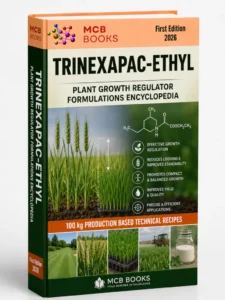
The TRINEXAPAC-ETHYL PLANT GROWTH REGULATOR FORMULATIONS ENCYCLOPEDIA provides practical technical information on formulation systems, raw material functions, manufacturing procedures and commercial production principles. Properly designed and manufactured Trinexapac-Ethyl products can provide professional solutions for plant height control, internode reduction, stem strengthening, lodging management and efficient crop production.