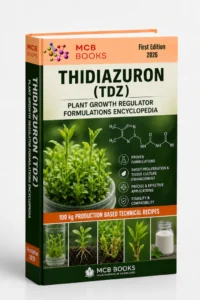
 Thidiazuron (TDZ) is a highly active plant growth regulator widely used in modern agriculture, horticulture and plant tissue culture applications. It is especially known for its strong cytokinin-like activity and its ability to influence cell division, shoot formation, plant regeneration, fruit development and various physiological processes. Because TDZ is effective at relatively low application rates, correct formulation, concentration control and manufacturing procedures are essential for obtaining consistent and reliable performance. The THIDIAZURON (TDZ) PLANT GROWTH REGULATOR FORMULATIONS ENCYCLOPEDIA provides practical technical information for professionals who want to understand the formulation and commercial production of TDZ-based plant growth regulator products.
TDZ formulations can be developed in different product forms depending on the intended agricultural or laboratory application. These may include soluble concentrates, suspension concentrates, liquid concentrates, wettable powders and specialized formulations for plant tissue culture. A successful TDZ formulation requires careful selection of solvents, dispersing agents, wetting agents, stabilizers, preservatives, pH regulators and other auxiliary raw materials. The compatibility of these ingredients directly affects product stability, active ingredient distribution, storage life and field performance.
One of the most important application areas of thidiazuron is plant tissue culture and micropropagation. TDZ can promote shoot induction, adventitious bud formation and plant regeneration in many plant species. It is frequently studied and used in protocols involving ornamental plants, fruit crops, forestry species and economically important agricultural plants. Correct concentration is particularly important because excessive TDZ levels may result in abnormal shoot development or difficulties during rooting and acclimatization.
In commercial agriculture, TDZ may also be used for specific crop management purposes such as fruit development, fruit sizing, defoliation or other regulated physiological responses, depending on crop type, registered use and local agricultural regulations. Formulation technology must therefore be designed according to the intended application method, including foliar spraying, dilution in water or controlled laboratory use.
The THIDIAZURON (TDZ) PLANT GROWTH REGULATOR FORMULATIONS ENCYCLOPEDIA also focuses on manufacturing principles such as raw material charging order, mixing conditions, dissolution or dispersion procedures, homogenization, pH adjustment, filtration, quality control and packaging. These production parameters help manufacturers obtain homogeneous and stable TDZ products suitable for professional and commercial use.
Quality control is another essential part of TDZ manufacturing. Important parameters may include active ingredient concentration, pH, appearance, density, viscosity, suspension stability, dispersibility and storage stability. Proper testing helps ensure that every production batch meets the required technical specifications.
For manufacturers, agricultural formulators, researchers and product development specialists, the THIDIAZURON (TDZ) PLANT GROWTH REGULATOR FORMULATIONS ENCYCLOPEDIA serves as a practical reference covering TDZ formulation technology, raw materials, manufacturing methods, applications and commercial production considerations. It provides a structured foundation for developing effective, stable and professionally manufactured thidiazuron plant growth regulator products.