How to produce urea fertilizer is one of the most important topics in modern fertilizer manufacturing because urea remains one of the most widely used nitrogen fertilizers in global agriculture. Its high nitrogen content, cost efficiency, and strong crop performance make it an essential fertilizer for cereals, vegetables, fruits, and commercial farming systems. As agricultural demand continues to grow, many fertilizer manufacturers focus on improving production efficiency and developing reliable urea fertilizer systems for large-scale agriculture.
Modern urea fertilizer production requires more than simple chemical processing. Manufacturers must carefully manage raw material quality, nitrogen concentration, production stability, and formulation consistency to create fertilizers that deliver effective agricultural performance. Understanding the manufacturing process is essential for companies looking to develop commercial fertilizer products for modern farming applications.
🚀 READY TO START PROFESSIONAL FERTILIZER PRODUCTION?
Building successful fertilizer products requires more than basic nutrient mixing. Modern fertilizer manufacturing depends on balanced formulations, reliable production systems, and commercial-grade fertilizer technologies designed for real agricultural performance.
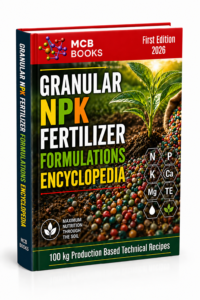
The GRANULAR NPK FERTILIZER FORMULATIONS ENCYCLOPEDIA gives you direct access to:
✔ Professional granular NPK fertilizer formulations
✔ Industrial production and manufacturing systems
✔ Commercial fertilizer technologies
✔ Raw material and formulation guidance
✔ Modern agricultural fertilizer concepts
Whether you are planning to launch a fertilizer business or improve existing fertilizer products, this encyclopedia helps you move faster with practical and production-focused formulation knowledge.
👉 Start developing professional fertilizer products for modern agriculture today.
RAW MATERIALS REQUIRED
-
Ammonia (NH₃)
-
Carbon dioxide (CO₂) (by-product of ammonia production)
-
Process water
-
Additives (anti-caking agents, formaldehyde – optional)
CHEMICAL REACTIONS INVOLVED
Step 1 – Carbamate Formation
Ammonia reacts with carbon dioxide under high pressure to form ammonium carbamate.
NH₃ + CO₂ → NH₂COONH₄
(Exothermic reaction)
Step 2 – Dehydration to Urea
Ammonium carbamate is dehydrated to form urea and water.
NH₂COONH₄ → CO(NH₂)₂ + H₂O
(Endothermic reaction)
INDUSTRIAL STEPS TO PRODUCE UREA FERTILIZER
1. AMMONIA AND CO₂ COMPRESSION
-
Ammonia and carbon dioxide are compressed to high pressure
-
Ensures efficient reaction in the synthesis reactor
2. UREA SYNTHESIS (REACTOR STAGE)
-
Compressed NH₃ and CO₂ are fed into a high-pressure reactor
-
Ammonium carbamate forms first
-
Partial conversion to urea occurs
Operating conditions
-
High pressure
-
Elevated temperature
3. STRIPPING AND RECOVERY
-
Unreacted ammonia and CO₂ are removed
-
Stripping gases are recovered and recycled
-
Improves process efficiency and reduces raw material loss
4. UREA SOLUTION CONCENTRATION
-
Urea solution is concentrated by evaporation
-
Water content is reduced
-
Produces molten urea suitable for solidification
5. SOLIDIFICATION (PRILLING OR GRANULATION)
A. Prilling Process
-
Molten urea sprayed from top of a prilling tower
-
Droplets solidify while falling
-
Produces uniform prills
B. Granulation Process
-
Molten urea sprayed onto seed particles in a granulator
-
Granules grow by layering
-
Produces harder, dust-free particles
6. DRYING AND COOLING
-
Removes excess moisture
-
Improves mechanical strength
-
Prevents caking during storage
7. SCREENING
-
Separates on-size product
-
Oversize crushed and recycled
-
Fines returned to granulation
8. COATING (ANTI-CAKING TREATMENT)
-
Applied to prevent lump formation
-
Improves storage stability and flowability
9. PACKAGING AND STORAGE
-
Packed in moisture-proof bags or stored in bulk
-
Stored in dry, ventilated warehouses
For a more detailed explanation of industrial systems, raw materials, and commercial manufacturing technologies, you can also explore our complete urea fertilizer production process guide used in modern fertilizer manufacturing.
Urea Fertilizer Production Process
QUALITY CONTROL PARAMETERS
-
Nitrogen content (%)
-
Biuret level
-
Moisture content
-
Particle size distribution
-
Bulk density
-
Caking tendency
ADVANTAGES OF UREA NITROGENOUS FERTILIZER
-
Highest nitrogen concentration among solid fertilizers
-
Easy transportation and storage
-
Suitable for blending and coating
-
Widely compatible with other fertilizers
Although urea remains one of the most effective nitrogen fertilizers used in modern agriculture, understanding both the benefits and limitations is important for balanced fertilizer management. You can also read our detailed guide about urea fertilizer advantages and disadvantages for modern agriculture.
Urea Fertilizer Advantages and Disadvantages
APPLICATION AREAS
-
Cereals
-
Oilseeds
-
Vegetables
-
Fruits
-
Pasture and forage crops
ENVIRONMENTAL CONSIDERATIONS
-
Risk of ammonia volatilization if misapplied
-
Use of urease inhibitors improves nitrogen efficiency
-
Proper timing and placement reduce losses
SUMMARY
Urea nitrogenous fertilizer is produced through ammonia–carbon dioxide synthesis, followed by concentration, solidification, and finishing steps. Modern urea plants focus on high conversion efficiency, recycling of unreacted gases, and production of high-quality granules suitable for global agricultural use.