 Algae biostimulant fertilizer production requires careful control of raw materials, processing conditions, formulation stability, and packaging to obtain a consistent commercial product. Seaweed extracts, kelp concentrates, macroalgae derivatives, microalgae ingredients, amino acids, humic substances, micronutrients, and other functional components may be used in different formulations. Each production stage should be designed according to the characteristics of the selected raw materials and the intended agricultural application.
Extraction is one of the most important stages in algae biostimulant production. Seaweed and algae materials can be processed through different extraction methods depending on the desired composition and final product type. Water-based extraction, alkaline extraction, enzymatic processing, and other controlled techniques may be used to obtain soluble algae-derived compounds. Extraction temperature, pH, processing time, and raw material quality can influence the properties of the final extract. Manufacturers should select an extraction method that provides good solubility, consistency, and compatibility with the intended fertilizer formulation.
After extraction or preparation of the algae concentrate, the mixing stage begins. Water is generally added to a suitable mixing vessel, followed by algae extract and other water-soluble ingredients. Amino acids, humic and fulvic acids, potassium sources, micronutrients, organic acids, stabilizers, and preservatives may be incorporated depending on the product design. The order of addition is important because incompatible ingredients can cause precipitation, sediment formation, excessive viscosity, or phase separation.
pH control is another critical factor in algae biostimulant fertilizer manufacturing. The pH level can affect nutrient solubility, product stability, preservative performance, and compatibility between ingredients. Manufacturers should monitor pH throughout production and make controlled adjustments when necessary. Sudden or excessive pH correction should be avoided because it can negatively affect the formulation.
Stability testing is essential before commercial production. Important parameters include appearance, color, odor, pH, density, viscosity, solubility, sediment formation, phase separation, and storage behavior. Products intended for fertigation should remain sufficiently soluble to reduce the risk of irrigation system blockage, while foliar formulations should provide good dispersion and application properties.
Filtration and homogenization may be used before packaging to improve product uniformity and remove unwanted particles. Packaging materials should be selected according to the chemical characteristics of the formulation. Containers must provide adequate protection during storage, transportation, and distribution while remaining compatible with the finished product.
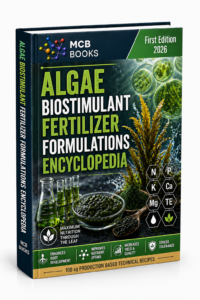
The ALGAE BIOSTIMULANT FERTILIZER FORMULATIONS ENCYCLOPEDIA provides practical technical information about algae extraction, mixing procedures, pH control, stability testing, filtration, packaging, and commercial production methods. It is designed for fertilizer manufacturers, formulators, agricultural chemical companies, and entrepreneurs seeking to develop professional algae and seaweed-based biostimulant fertilizers with reliable quality and production consistency.