Introduction
Car tire polish gels are widely used in automotive detailing to improve the appearance of tyres and protect rubber surfaces against environmental effects.
Although these products are often considered simple, their performance depends heavily on how the formulation is designed. A well-balanced gel should provide consistent shine, good adhesion to the surface, and long-lasting durability without leaving excessive residue.
For manufacturers, the real challenge is not just making the product, but ensuring that it performs reliably under different conditions.
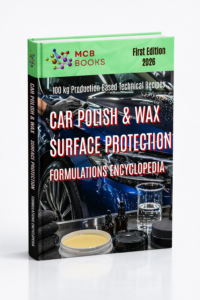
Includes tire polish gels, surface protection systems, and production-ready formulations.
👉 CAR POLISH & WAX SURFACE PROTECTION FORMULATIONS ENCYCLOPEDIA
In industrial car care production, liquid-based tire shine systems are widely preferred for consistent results and scalability.
For more advanced liquid tire shine formulations and concentrated systems, check this guide:
https://makingchembooks.com/making-concentrated-car-tyre-shiner-formula-ingredients/
What is a Tire Polish Gel?
A tire polish gel is a semi-viscous formulation designed to restore the appearance of tyres while forming a protective layer on the rubber surface.
Compared to liquid products, gels tend to:
- stay longer on the surface
- provide more controlled application
- deliver a deeper and more uniform finish
Depending on the formulation, the product can produce either a natural satin look or a high-gloss effect.
Key Components in Tire Gel Formulation
A typical tire polish gel includes several functional ingredients:
- Silicone systems → provide shine and water repellency
- Thickeners → create gel structure and improve application
- Carriers (water or solvent) → control consistency
- Emulsifiers → stabilize the formulation
- Additives → improve durability and surface conditioning
The balance between these components determines how the product behaves during application and after drying.
Production Process Overview
The production of tire polish gel usually involves a controlled mixing process.
The base phase is prepared first, followed by thickeners and stabilizers. Silicone components are added gradually under mixing to ensure proper dispersion.
Finally, additives are incorporated and the mixture is adjusted until the desired viscosity and stability are achieved.
Although the process is relatively straightforward, maintaining consistency is important, especially in repeated production.
Performance Factors to Consider
In practical applications, several factors affect product performance:
- viscosity level and spreadability
- drying behavior
- resistance to dust and dirt
- durability under outdoor conditions
A well-formulated gel should provide a uniform finish without streaking or excessive buildup.
Understanding Gel-Based Systems
Not all tire shine products are formulated the same way.
Some are designed for quick visual results, while others focus on durability and long-term protection. Gel-based systems are often preferred when a thicker, more controlled application is required.
👉 If you want to explore a more detailed formulation approach:
👉 Tire Shine Gel Formula (Car Care + Production Process Guide)
This gives a more detailed look at how formulation choices affect performance.
Part of a Larger Detailing System
In real-world use, tire polish gels are rarely used alone.
They are part of a broader detailing process that includes:
- surface cleaning
- polishing
- protection
Connection with Surface Protection Products
Tire gels are closely related to other surface protection products such as waxes and coatings.
These products are designed to enhance appearance while providing a protective layer against environmental effects.
👉 CAR POLISH & WAX SURFACE PROTECTION FORMULATIONS ENCYCLOPEDIA
Understanding this connection helps in developing products that work well together.
SUMMARY
Car tire polish gel formulations are more than simple appearance products. They combine surface conditioning, protection, and visual enhancement in a single system.
While the production process itself is relatively simple, formulation balance plays a key role in achieving consistent results.
In practice, these products are often developed as part of a wider surface protection system, where different formulations are designed to complement each other.
👉 This approach makes it easier to move from individual products to a more complete and scalable automotive detailing range.
Related Articles
If you want to see how different car care products are connected:
👉 Car Care Products Formulation System (Complete Automotive Chemical Production Guide)
This helps place individual formulations into a complete system.