Introduction
EDTA chelated iron fertilizer is one of the most widely used micronutrient formulations in modern agriculture, designed to prevent and correct iron deficiency in plants. Iron is essential for chlorophyll production, and its deficiency leads to chlorosis, reduced growth, and lower crop yield.
EDTA acts as a chelating agent that binds iron ions and keeps them soluble and available for plant uptake, even in challenging soil conditions. In this guide, you will learn EDTA iron fertilizer formulas, raw materials, and step-by-step production methods used in industrial fertilizer manufacturing.
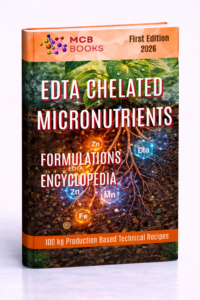
Discover advanced micronutrient formulations in the EDTA Chelated Micronutrients Formulations Encyclopedia, developed by a chemical engineer with over 40 years of experience.
What is EDTA Chelated Iron?
EDTA chelated iron (Fe-EDTA) is a complex formed between iron and ethylenediaminetetraacetic acid (EDTA). This chelation process prevents iron from reacting with soil components and becoming insoluble.
As a result, iron remains available for plant absorption, making it highly effective in agricultural applications.
EDTA Chelated Iron Fertilizer Formula (Example)
A typical Fe-EDTA fertilizer formulation may include:
- Iron source (FeSO₄ or FeCl₃): 10–15%
- EDTA: equivalent chelating ratio
- Water: balance
- pH adjusters: small amounts
The formulation must ensure complete chelation for maximum stability and effectiveness.
Production Process of Fe-EDTA
1. Raw Material Preparation
Iron salts and EDTA are accurately measured.
2. Dissolution
EDTA is dissolved in water under controlled conditions.
3. Chelation Reaction
Iron is slowly added while maintaining proper pH to form the Fe-EDTA complex.
4. pH Adjustment
The solution is adjusted to an optimal pH for stability.
5. Filtration and Packaging
The final solution is filtered and packed for use.
Stability and pH Effect
The stability of EDTA chelated iron depends strongly on pH:
- Stable up to pH ~6
- Efficiency decreases in alkaline soils
- May require alternative chelates at higher pH
Proper pH control is critical in formulation design.
EDTA vs DTPA vs EDDHA
Different chelating agents are used depending on soil conditions:
- EDTA: effective in slightly acidic soils
- DTPA: moderate stability
- EDDHA: high stability in alkaline soils
Selecting the correct chelate improves fertilizer performance.
Uses of EDTA Chelated Iron
EDTA iron fertilizers are widely used in:
- Correcting iron deficiency (chlorosis)
- Foliar applications
- Hydroponic systems
- Fertigation systems
👉 Related application:
https://makingchembooks.com/making-liquid-npk-fertilizer-manufacturing-process/
Advantages of EDTA Chelated Fertilizers
- Improves nutrient availability
- Prevents precipitation of iron
- Enhances plant growth
- Easy application
- Suitable for multiple systems
Formulation Tips
- Maintain correct molar ratio of EDTA to iron
- Control pH during reaction
- Ensure complete chelation
- Use high-purity raw materials
Advanced formulation techniques are detailed in the EDTA Chelated Micronutrients Formulations Encyclopedia.
Safety and Handling
- Handle chemicals with care
- Use protective equipment
- Store in appropriate containers
- Follow industrial safety standards
Frequently Asked Questions (FAQ)
What is EDTA chelated iron?
It is a stable complex that keeps iron available for plant uptake.
Why use chelated iron fertilizers?
They prevent nutrient loss and improve plant absorption.
What is the best chelate for iron?
It depends on soil pH; EDTA is suitable for slightly acidic conditions.
How is Fe-EDTA produced?
By reacting iron salts with EDTA under controlled pH conditions.
Author
This content is prepared by a professional chemical engineer with over 40 years of formulation experience.
SUMMARY
EDTA chelated iron fertilizer is a highly effective micronutrient solution designed to improve plant growth and correct iron deficiency. By maintaining iron in a soluble and bioavailable form, EDTA enhances nutrient efficiency and agricultural productivity.
Understanding formulation, production process, and application methods allows manufacturers to develop high-quality micronutrient fertilizers suitable for modern agricultural systems.
Related Articles
- https://makingchembooks.com/making-liquid-npk-fertilizer-manufacturing-process/
- https://makingchembooks.com/how-to-make-npk-fertilizer/
- https://makingchembooks.com/zinc-sulfate-fertilizer-production/
- https://makingchembooks.com/zinc-fertilizer-production-equipment/
- https://makingchembooks.com/zinc-deficiency-in-plants/