INTRODUCTION
How to make urea fertilizer is one of the most searched topics in modern fertilizer production because urea remains one of the most widely used nitrogen fertilizers in agriculture. Its high nitrogen content, affordable cost, and strong crop performance make it an important fertilizer for cereals, vegetables, fruits, and commercial farming systems around the world. For this reason, both fertilizer manufacturers and agricultural businesses continue to invest in professional urea fertilizer production technologies.
Understanding the urea fertilizer production process is essential for developing efficient and commercially successful fertilizer products. Modern manufacturing systems focus on raw material quality, nitrogen efficiency, production stability, and proper formulation techniques to create fertilizers that deliver reliable agricultural performance under different farming conditions.
For advanced fertilizer formulations and industrial production systems, you can explore:
GRANULAR NPK FERTILIZER FORMULATIONS ENCYCLOPEDIA
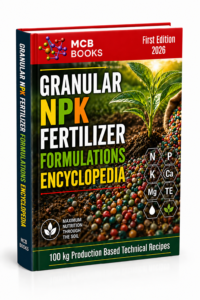
Discover professional fertilizer formulations and industrial production methods developed by experienced chemical engineers.
WHAT IS UREA FERTILIZER?
Urea fertilizer is a nitrogen-rich compound containing approximately 46% nitrogen, making it one of the most efficient fertilizers used in agriculture.
It is widely applied to soil and crops to support plant growth, increase yield, and improve crop quality.
If you want to learn more about industrial manufacturing systems, raw materials, and commercial fertilizer technologies, you can also read our detailed guide about the urea fertilizer production process used in modern fertilizer manufacturing.
Urea Fertilizer Production Process
CHEMICAL REACTION
The production of urea fertilizer is based on the reaction between ammonia and carbon dioxide:
Ammonia + Carbon Dioxide → Ammonium Carbamate → Urea + Water
This reaction takes place under high pressure and temperature in industrial reactors.
RAW MATERIALS
The main raw materials used in urea fertilizer production are:
- Ammonia (NH₃)
- Carbon dioxide (CO₂)
Additional materials may be used for processing, stabilization, and granulation.
For a broader understanding of fertilizer systems, see:
NPK Fertilizer Production Process
https://makingchembooks.com/npk-fertilizer-production-process/
PRODUCTION PROCESS
The production of urea fertilizer involves several industrial steps.
First, ammonia and carbon dioxide are combined under high pressure to form ammonium carbamate. This intermediate compound is then dehydrated to produce urea.
The molten urea is further processed into prills or granules, which are easier to handle and apply in agricultural applications.
The final product is cooled, dried, and packaged.
ADVANTAGES OF UREA FERTILIZER
Urea fertilizer provides high nitrogen content, making it cost-effective and efficient for agricultural use.
It is easy to store, transport, and apply, and it supports rapid plant growth and increased crop productivity.
While urea remains one of the most widely used nitrogen fertilizers in agriculture, understanding both the benefits and potential limitations is important for efficient fertilizer use and balanced crop nutrition. You can also explore our detailed guide about urea fertilizer advantages and disadvantages in modern agriculture.
Urea fertilizer advantages and disadvantages
LIMITATIONS
Urea fertilizer can lose nitrogen through volatilization if not properly applied.
Proper usage and application techniques are important to ensure maximum efficiency.
For alternative nitrogen sources, see:
Monoammonium Phosphate MAP Fertilizer Production Process
https://makingchembooks.com/ammonium-nitrate-fertilizer-production/
APPLICATION AREAS
Urea fertilizer is widely used in agriculture, including field crops, vegetables, fruits, and industrial farming systems.
It is one of the most important fertilizers in global agricultural production.
SUMMARY
Urea fertilizer production is a critical industrial process that supports global agriculture.
By understanding the formulation, raw materials, and production steps, manufacturers and users can optimize fertilizer efficiency and improve crop performance.
For complete industrial fertilizer formulations, explore:
GRANULAR NPK Fertilizers Formulations Encyclopedia
https://makingchembooks.com/product/granular-npk-fertilizer-formulations-encyclopedia/
RELATED ARTICLES
NPK Fertilizer Production Process
https://makingchembooks.com/npk-fertilizer-production-process/
Monoammonium Phosphate MAP Fertilizer Production Process
https://makingchembooks.com/ammonium-nitrate-fertilizer-production/
Diammonium Phosphate DAP Fertilizer Production Process
https://makingchembooks.com/chemical-fertilizer-types-and-uses/