 Manufacturing bio pesticides for pepper production requires a combination of appropriate biological active ingredients, compatible formulation additives, controlled processing conditions, and reliable quality control. Because pepper plants can be affected by insects, mites, fungal diseases, and soil-borne pathogens, biological pesticide products may be designed for foliar, soil, root-zone, or seedling applications.
The first stage of production is selecting the biological active material according to the target pest or disease. Bio pesticide formulations may contain beneficial microorganisms, microbial metabolites, botanical extracts, naturally derived compounds, enzymes, or other biologically active substances. Products intended for thrips, aphids, whiteflies, mites, caterpillars, or leaf miners may require different formulation characteristics from products developed against powdery mildew, Botrytis, Fusarium, Pythium, Rhizoctonia, or root rot.
Raw material selection is one of the most important parts of commercial bio pesticide manufacturing. Besides the active component, formulations may contain carriers, wetting agents, dispersing agents, emulsifiers, suspending agents, stabilizers, adhesion enhancers, anti-foaming agents, protective additives, and compatible preservatives. Each ingredient must be selected carefully because unsuitable surfactants, preservatives, extreme pH conditions, or aggressive processing can negatively affect microbial viability or the stability of botanical active materials.
The manufacturing process generally begins with preparation of the carrier or liquid phase. Water quality should be checked before production because excessive hardness, chlorine, contamination, or unsuitable pH may affect formulation performance. Functional additives are introduced according to a controlled mixing sequence, followed by the active biological component under suitable processing conditions.
Temperature control is especially important during manufacturing. Many biological ingredients are sensitive to excessive heat, while some microorganisms can lose viability if exposed to harsh mixing or prolonged processing. For this reason, microbial formulations may require gentle agitation and lower processing temperatures. Botanical formulations, on the other hand, may require controlled emulsification, dispersion, or homogenization to produce a stable and uniform product.
Commercial pepper bio pesticides can be manufactured in different forms, including liquid concentrates, suspension formulations, microbial preparations, botanical emulsions, wettable powders, and water-dispersible products. The choice of formulation depends on the active ingredient, target pest or pathogen, application method, storage requirements, and intended field performance.
Quality control is essential before packaging. Important parameters may include appearance, pH, density, viscosity, dispersibility, suspension stability, emulsion stability, microbial viability where applicable, contamination levels, active ingredient consistency, and storage stability. Biological performance testing is also important to confirm that the finished product maintains its intended activity.
Packaging should protect sensitive formulations from excessive heat, moisture, oxygen, and ultraviolet light when necessary. Storage and application instructions should also be clearly defined to preserve product performance throughout its shelf life.
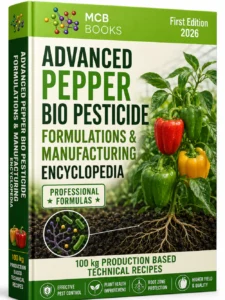
The Advanced Pepper Bio Pesticide Formulations & Manufacturing Encyclopedia provides practical technical guidance on formulation design, raw material functions, production methods, quality control, and commercial manufacturing. It is a valuable resource for companies seeking to develop professional biological pest and disease control products specifically for modern pepper production.