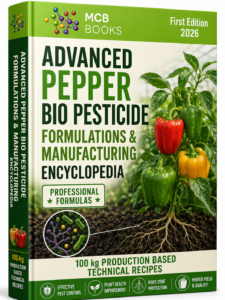
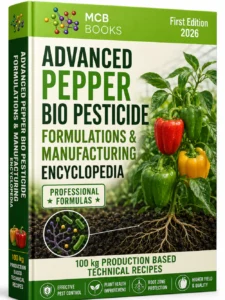
The Advanced Pepper Bio Pesticide Formulations & Manufacturing Encyclopedia provides practical technical information for developing biological crop protection products specifically for pepper production. Using a 100 kg formulation basis gives manufacturers a clear reference for understanding ingredient ratios, raw material functions, production planning, and scale-up requirements for commercial and professional bio pesticide manufacturing.
Pepper crops can be affected by numerous pests, including thrips, aphids, whiteflies, mites, caterpillars, and leaf miners. These pests may damage leaves, flowers, shoots, and developing fruits, reducing plant vigor, fruit quality, and overall crop yield. Biological pesticide formulations can be designed using suitable microbial agents, botanical extracts, naturally derived active substances, microbial metabolites, enzymes, or other biologically active materials.
A typical 100 kg bio pesticide formulation may contain the main biological active ingredient together with suitable carriers, wetting agents, dispersing agents, emulsifiers, stabilizers, suspending agents, adhesion enhancers, anti-foaming agents, protective additives, and compatible preservatives. The exact formulation depends on the target organism, active ingredient, intended application method, and required product stability.
Thrips and whiteflies often remain on protected plant surfaces, flowers, or the undersides of leaves. For this reason, formulations intended for these pests should provide effective wetting, spreading, and coverage. Aphid and mite control products likewise require suitable surface contact and formulation stability to support consistent application performance.
Pepper crops are also susceptible to fungal and soil-borne diseases such as powdery mildew, Botrytis, Fusarium, Pythium, Rhizoctonia, damping-off, and root rot. Biological fungicide components may be incorporated into products designed for foliar spraying, soil treatment, root-zone applications, or seedling protection. Depending on the active material, these products may work through competition, microbial antagonism, naturally derived antifungal activity, or other biological mechanisms.
During 100 kg batch production, manufacturers must carefully control water quality, pH, temperature, mixing speed, addition sequence, and processing time. Biological active ingredients may be sensitive to excessive heat, unsuitable pH, aggressive homogenization, or incompatible formulation additives. Maintaining appropriate processing conditions is therefore essential for preserving biological activity.
Quality control should include parameters such as appearance, pH, viscosity, density, dispersibility, suspension or emulsion stability, microbial viability where applicable, contamination levels, storage stability, and biological performance. Appropriate packaging also helps protect sensitive formulations against moisture, heat, oxygen, and ultraviolet exposure.
The Advanced Pepper Bio Pesticide Formulations & Manufacturing Encyclopedia serves as a practical reference for manufacturers developing 100 kg biological pesticide formulations for pepper crops. By combining formulation principles, raw material selection, production procedures, quality control, and crop-specific pest management concepts, it supports the development of reliable biological solutions for modern pepper production.