 The production of fertilizers for drip irrigation systems is an important and rapidly developing field within the agricultural chemical industry. Modern growers require highly soluble, stable, concentrated, and easy-to-apply fertilizer products that can deliver essential nutrients directly to the plant root zone. For manufacturers, working with 100 kg drip irrigation fertilizer formulas provides a practical basis for batch preparation, production planning, raw material calculation, quality control, and commercial scaling.
Drip irrigation fertilizers are used through fertigation systems, where nutrients are mixed with irrigation water and distributed through pipes and emitters. These fertilizers may be manufactured as liquid concentrates, water-soluble powders, NPK blends, micronutrient solutions, organic-mineral fertilizers, root-development products, flowering fertilizers, or fruit-development formulations. Each product must be designed according to the nutritional needs of the target crop and the technical requirements of the irrigation system.
A 100 kg production formula allows manufacturers to calculate every ingredient as a clear percentage of the total batch. For example, 1 kg of a raw material in a 100 kg formula represents 1% of the finished product. This structure simplifies formula evaluation and makes it easier to scale production to 500 kg, 1,000 kg, or larger industrial batches. However, larger-scale production should always be supported by pilot testing because mixing efficiency, heat formation, dissolution time, and raw material behavior may change as the batch size increases.
Raw material selection is one of the most critical stages of fertilizer formulation. Common ingredients may include nitrogen sources, phosphates, potassium salts, magnesium compounds, trace elements, chelating agents, organic acids, pH regulators, stabilizers, and purified water. The selected materials must provide the required nutrient analysis while maintaining complete solubility and long-term product stability.
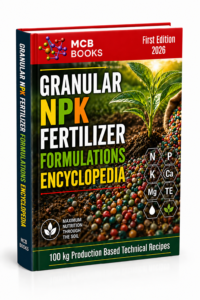
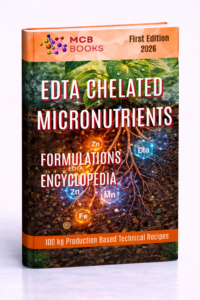
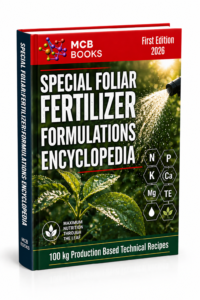
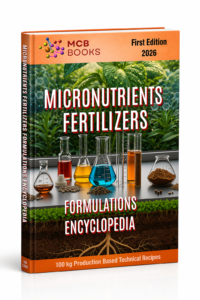
The Drip Irrigation Fertilizer Formulations Encyclopedia presents practical information for companies and entrepreneurs interested in professional fertilizer manufacturing. It includes production-oriented formulas, raw material functions, preparation methods, product characteristics, technical specifications, and application guidance. The book can serve as a useful reference for both new investors and experienced agricultural chemical manufacturers.
Chemical compatibility must be evaluated carefully when developing concentrated fertilizers. Calcium compounds may react with phosphate or sulfate sources and form insoluble particles. These particles can create sediment inside the package or clog drip irrigation filters and emitters. For this reason, incompatible nutrients may need to be separated into different products or supplied through A and B fertilizer tanks.
The manufacturing process generally begins by transferring a calculated amount of suitable water into a corrosion-resistant mixing tank. Agitation is then started, and the raw materials are added gradually in the correct order. Each solid ingredient should dissolve completely before another material is introduced. Product temperature, pH, mixing speed, and addition time should be controlled throughout production. After mixing, the fertilizer may be filtered before being transferred to the packaging unit.
Commercial fertilizer production also requires a detailed quality-control program. Finished products should be tested for nutrient content, pH, density, electrical conductivity, appearance, solubility, dilution stability, crystallization tendency, and storage performance. Powder fertilizers should be checked for moisture absorption and caking, while liquid products should be monitored for separation, precipitation, or color changes.
The Drip Irrigation Fertilizer Formulations Encyclopedia helps readers understand how 100 kg fertilizer formulas can be converted into commercially applicable products. It also supports the development of fertilizers for greenhouse crops, vegetables, fruit trees, field crops, ornamental plants, nurseries, and soilless growing systems.
With carefully designed formulas, compatible raw materials, controlled production procedures, and reliable quality testing, manufacturers can produce efficient drip irrigation fertilizers for the professional agricultural market. Using standardized 100 kg formulations can make production calculations clearer, improve batch consistency, and support the development of a competitive commercial fertilizer product range.