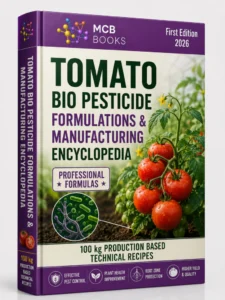
Tomato production is highly vulnerable to a wide range of insect pests, mites, fungal diseases, bacterial problems and soil-borne pathogens. Whiteflies, aphids, thrips, spider mites, leaf miners, caterpillars, powdery mildew, early blight, late blight, Botrytis, root rots and other diseases can significantly reduce plant growth, fruit quality and total crop yield. For this reason, biological crop protection products are becoming increasingly important in modern tomato production systems. TOMATO BIO PESTICIDE FORMULATIONS & MANUFACTURING ENCYCLOPEDIA provides practical technical information about the formulation, production and application of bio pesticides specifically developed for tomato crops.
Bio pesticides can be manufactured using microorganisms, botanical extracts, natural oils, fermentation products, plant-derived active substances and other biologically based ingredients. Depending on the target organism, formulations may include microbial agents such as Bacillus species, Trichoderma species, Beauveria bassiana, Metarhizium anisopliae and other beneficial microorganisms. Botanical ingredients such as neem derivatives, garlic extracts, essential oils and naturally derived compounds may also be incorporated into bio insecticide, bio fungicide or bio acaricide formulations.
The TOMATO BIO PESTICIDE FORMULATIONS & MANUFACTURING ENCYCLOPEDIA explains how different formulation components work together to create stable and effective commercial products. Besides the main biological active ingredients, formulations may require emulsifiers, dispersing agents, wetting agents, stabilizers, preservatives, carriers, thickeners, antifoaming agents and pH-control materials. Correct selection of these raw materials is important for maintaining product stability, microbial viability, suspension quality, storage performance and field effectiveness.
Manufacturing methods vary according to the type of biological pesticide being produced. Liquid concentrates, suspension concentrates, emulsifiable biological formulations, wettable powders, soluble powders and microbial suspensions may require different production processes. Typical manufacturing stages include raw material preparation, controlled mixing, homogenization, pH adjustment, filtration, microbial incorporation, viscosity adjustment, filling and packaging. Temperature control is especially important when formulations contain living microorganisms because excessive heat can reduce biological activity.
Tomato bio pesticides can be designed for foliar spraying, root-zone application, soil treatment, seedling treatment, greenhouse production and integrated pest management programs. Preventive applications are particularly valuable because many biological control agents perform best before pest populations or disease pressure become severe.
Quality control is another essential part of commercial manufacturing. Parameters such as pH, viscosity, density, microbial concentration, particle size, suspension stability, emulsion stability, storage stability and contamination control should be monitored according to the formulation type.
With practical formulation concepts, raw material functions and commercial production principles, TOMATO BIO PESTICIDE FORMULATIONS & MANUFACTURING ENCYCLOPEDIA serves as a technical reference for manufacturers, agricultural product developers, formulators and professionals interested in producing biological crop protection products for tomato cultivation. It provides a structured foundation for developing effective, stable and commercially applicable bio pesticide formulations for sustainable tomato production.