Algae biostimulant fertilizers are increasingly used in professional agriculture because they can support root development, nutrient uptake, plant growth, crop quality, and tolerance to environmental stress. For fertilizer manufacturers, developing reliable 100 kg algae biostimulant fertilizer formulas is an important step toward consistent commercial and industrial production. These formulations can be designed as liquid concentrates, foliar fertilizers, fertigation products, root stimulants, or multifunctional plant nutrition solutions.
A typical 100 kg algae biostimulant fertilizer formulation may contain seaweed extract, kelp extract, macroalgae or microalgae derivatives, amino acids, humic substances, fulvic acids, potassium sources, micronutrients, organic acids, wetting agents, stabilizers, preservatives, and water. The exact percentages depend on the target crop, application method, desired nutrient profile, and product positioning. Every raw material should have a defined technical function and should be selected according to its compatibility with the other ingredients in the formula.
One of the main advantages of working with a 100 kg production formula is that manufacturers can clearly calculate raw material quantities and prepare reproducible batches. The formulation can also be scaled up for larger industrial production. For example, a properly developed 100 kg formula can be adapted to 500 kg, 1,000 kg, or larger batch sizes by maintaining the same ingredient ratios, provided that mixing capacity, process conditions, and quality-control requirements are also adjusted accordingly.
The manufacturing process generally begins with the addition of a calculated amount of water to a suitable mixing tank. Water-soluble ingredients are then introduced gradually under controlled agitation. Seaweed or algae extracts are added according to their solubility and physical characteristics, followed by additional nutrients, amino acids, humic materials, micronutrients, and functional additives. pH adjustment, homogenization, filtration, and final weight correction are commonly performed before packaging.
Industrial algae biostimulant fertilizer production requires careful attention to stability. Incompatible ingredients may cause precipitation, sedimentation, excessive viscosity, phase separation, or changes in pH during storage. Manufacturers should therefore evaluate solubility, density, appearance, viscosity, nutrient content, storage stability, and packaging compatibility before commercial release.
Different 100 kg algae fertilizer formulas can also be developed for specific agricultural purposes. These may include formulations for foliar application, fertigation, root development, flowering support, fruit development, nutrient uptake, transplant recovery, or abiotic stress management. Combining algae extracts with amino acids, potassium, micronutrients, or humic substances can create specialized commercial products for different crop programs.
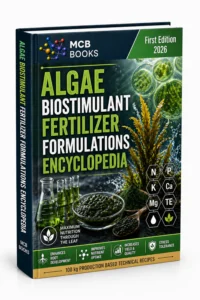
The ALGAE BIOSTIMULANT FERTILIZER FORMULATIONS ENCYCLOPEDIA provides practical information about 100 kg algae biostimulant fertilizer formulas, raw materials, manufacturing processes, production methods, quality control, and commercial product development. It is a useful technical reference for fertilizer manufacturers, formulators, agricultural chemical companies, and entrepreneurs interested in producing professional seaweed extract, kelp, and algae-based biostimulant fertilizers for modern agriculture.