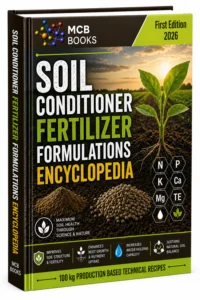
 Soil quality is one of the most important factors affecting plant growth, nutrient availability, root development and agricultural productivity. Intensive cultivation, salinity, low organic matter, poor soil structure and improper irrigation can gradually reduce soil performance. For this reason, soil conditioner fertilizers are widely used in modern agriculture to improve the physical, chemical and biological properties of soils. The SOIL CONDITIONER FERTILIZER FORMULATIONS ENCYCLOPEDIA has been developed as a practical technical guide for professionals and companies interested in producing commercial soil conditioner products.
Soil conditioner formulations may contain different combinations of humic acid, fulvic acid, organic matter, mineral materials, calcium compounds, magnesium sources, gypsum, biochar, amino acids, seaweed extracts, micronutrients and other functional raw materials. The selection and ratio of these ingredients depend on the intended application, soil characteristics and final product type. Liquid, suspension, powder and granular soil conditioner fertilizers can therefore require different manufacturing processes and formulation strategies.
One of the most important stages in soil conditioner fertilizer production is selecting compatible raw materials. Each ingredient must have a specific function within the formulation. Humic and fulvic substances may support nutrient availability and soil organic matter, while calcium- and gypsum-based materials can be used in products designed for specific soil management purposes. Organic and mineral components may also be combined to develop products intended to improve soil aggregation, water-holding capacity and root-zone conditions.
Manufacturing soil conditioners requires more than simply mixing raw materials. Producers must consider raw material solubility, particle size, pH, viscosity, suspension stability, mixing order and storage performance. For granular products, additional operations such as blending, granulation, drying, screening and coating may be required. Correct production procedures help obtain homogeneous products with consistent commercial quality.
The SOIL CONDITIONER FERTILIZER FORMULATIONS ENCYCLOPEDIA provides practical formulation examples based on 100 kg production quantities, making the information easier to understand and adapt to professional manufacturing systems. It also explains the functions of raw materials, production processes, product specifications, technical characteristics and practical application principles.
For fertilizer manufacturers, agricultural input companies, formulation specialists and entrepreneurs planning to enter the soil improvement market, access to organized formulation knowledge can significantly simplify product development. Instead of relying only on trial-and-error production, manufacturers can use structured technical formulations as a starting point for laboratory trials, pilot production and commercial-scale manufacturing.
The SOIL CONDITIONER FERTILIZER FORMULATIONS ENCYCLOPEDIA is therefore a comprehensive reference for anyone who wants to understand how to manufacture soil conditioner fertilizers, develop different soil amendment products and establish a more systematic approach to commercial soil conditioner production.