 The commercial soil conditioner market continues to attract fertilizer manufacturers, agricultural input companies and entrepreneurs looking to develop products for soil improvement and professional crop production. However, producing a reliable soil conditioner requires more than selecting a few raw materials and mixing them together. Successful commercial soil conditioner production depends on formulation design, raw material compatibility, manufacturing technique, quality control and the intended agricultural application of the final product.
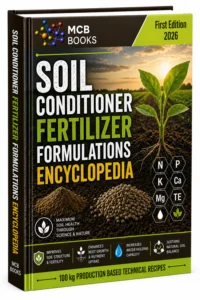
The SOIL CONDITIONER FERTILIZER FORMULATIONS ENCYCLOPEDIA has been developed as a practical technical resource for companies that want to manufacture different types of soil conditioner fertilizers. The encyclopedia provides structured formulations based on 100 kg production quantities, allowing manufacturers to clearly understand ingredient ratios and convert formulations into larger production batches when required.
Commercial soil conditioners can be produced in liquid, suspension, powder and granular forms. Each product type requires a different manufacturing approach. Liquid formulations may involve controlled dissolution, mixing, pH adjustment, filtration and stabilization. Suspension products require careful particle-size management and suitable dispersing or suspending systems. Powder products depend on homogeneous dry blending, while granular soil conditioners may require mixing, granulation, drying, screening and coating operations.
Raw material selection is one of the most important stages of product development. Depending on the intended function, formulations may include humic acid, fulvic acid, gypsum, calcium compounds, magnesium sources, biochar, organic matter, amino acids, seaweed extracts and micronutrients. Functional additives such as pH regulators, dispersing agents, stabilizers, preservatives and anti-caking materials may also be required to achieve suitable manufacturing and storage characteristics.
Different soil conditioner products can be designed for different market needs. Manufacturers may develop formulations intended for soil structure improvement, increased organic matter, improved water retention, root-zone development, nutrient availability, salinity management, sodic soil improvement or general soil fertility support. This enables companies to create specialized product ranges instead of relying on a single general-purpose soil conditioner.
Quality control is essential when moving from laboratory formulation to commercial production. Parameters such as pH, density, viscosity, moisture, particle size, appearance, sedimentation behavior, nutrient content and storage stability should be evaluated according to the type of product being manufactured. Maintaining batch-to-batch consistency is particularly important when products are distributed through professional agricultural markets.
The SOIL CONDITIONER FERTILIZER FORMULATIONS ENCYCLOPEDIA combines formulation information with raw material functions, production procedures, product specifications, technical characteristics and practical application guidance. This organized approach can help manufacturers reduce unnecessary trial-and-error work during product development and provide a stronger technical starting point for pilot and industrial-scale production.
For companies planning to establish or expand a soil conditioner product line, access to practical formulation knowledge can significantly simplify the development process. The SOIL CONDITIONER FERTILIZER FORMULATIONS ENCYCLOPEDIA provides a comprehensive technical foundation for producing professional soil conditioners and developing commercially viable products for modern agricultural markets.