Saline, alkaline and degraded soils can create serious limitations for agricultural production by restricting root development, reducing nutrient availability and negatively affecting soil structure. Excess salts, high sodium levels, unfavorable pH conditions, low organic matter and poor water infiltration can gradually reduce soil productivity. For these reasons, specialized soil conditioner formulations for saline, alkaline and degraded soils are widely used as part of professional soil-management programs.
Saline soils contain excessive concentrations of soluble salts within the root zone. High salinity can interfere with plant water uptake and may create unfavorable growing conditions even when sufficient irrigation water is available. Soil conditioner products developed for saline soils may contain humic acid, fulvic acid, organic matter, calcium sources, gypsum and selected mineral components. These ingredients can be incorporated into formulations intended to improve soil conditions and support more efficient management of the root zone.
Alkaline and sodic soils require a different formulation approach. High sodium levels can cause soil particles to disperse, resulting in poor aggregation, reduced water infiltration and limited aeration. Gypsum and other calcium-containing materials are frequently used in formulations designed for sodic soil management. Calcium can help replace exchangeable sodium under suitable soil conditions, while irrigation and drainage practices are important for removing displaced salts from the root zone.
Degraded soils often suffer from low organic matter, compaction, poor biological activity and reduced water-holding capacity. In these cases, organic soil conditioners containing humic substances, biochar, compost-derived materials or other organic components may be used to improve physical soil properties. These materials can also be combined with mineral components to produce organomineral soil conditioner formulations for professional agricultural use.
Application methods vary according to the formulation type. Liquid soil conditioners can be applied through drip irrigation, fertigation systems or soil-directed applications. Granular and powder products can be incorporated into the soil before planting, applied around the root zone or distributed during soil preparation. The application rate should always be determined according to soil analysis, crop requirements, product concentration and local agricultural conditions.
Manufacturing these products requires careful attention to raw material compatibility, pH, particle size, solubility, suspension stability and mixing sequence. Gypsum-based suspensions, humic acid liquids and biochar-containing granular products each require different production technologies to achieve consistent commercial quality.
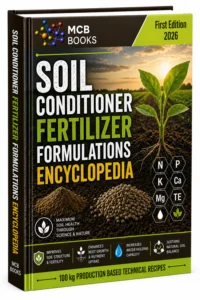
The SOIL CONDITIONER FERTILIZER FORMULATIONS ENCYCLOPEDIA provides practical formulation examples based on 100 kg production quantities, together with raw material functions, production methods, technical specifications and application guidance. These formulations can support laboratory trials, pilot-scale development and industrial manufacturing.
For fertilizer manufacturers and agricultural input companies, developing specialized soil conditioners for saline, alkaline and degraded soils creates opportunities to address important soil-management challenges. With the correct formulation strategy and application program, producers can develop professional products for salinity management, sodic soil improvement, organic matter enhancement and long-term soil rehabilitation.