 Healthy soil structure is essential for efficient root growth, water movement, nutrient availability and long-term agricultural productivity. Compacted soils, low organic matter, poor aggregation and limited water-holding capacity can restrict plant development and reduce fertilizer efficiency. For this reason, soil conditioner fertilizer formulations are increasingly developed to improve the physical and chemical properties of the root zone while supporting more favorable growing conditions.
One of the main purposes of a soil conditioner is improving soil structure. Well-structured soil contains stable aggregates that allow sufficient air and water movement while providing roots with space to expand. Materials such as humic acid, fulvic acid, organic matter, gypsum, calcium compounds and selected mineral components can be incorporated into formulations designed to support soil aggregation and reduce unfavorable compaction conditions.
Water retention is another important target in soil conditioner fertilizer development. Soils with poor water-holding capacity may dry rapidly, particularly under high temperatures or irregular irrigation conditions. Organic materials, humic substances, biochar and other porous components can be used in formulations intended to help the soil retain moisture within the active root zone. Better moisture management may also contribute to more efficient irrigation and more stable growing conditions.
Root development is closely connected to both soil structure and moisture availability. When the root zone is compacted, poorly aerated or unable to retain sufficient water, root expansion can be limited. A properly designed soil conditioner fertilizer for root development can help create a more suitable physical environment around the roots. Humic substances, organic components, calcium, magnesium, amino acids and selected micronutrients may also be incorporated into specialized formulations depending on the intended product concept.
Liquid soil conditioners are often designed for application through irrigation or fertigation systems, whereas powder and granular products may be applied directly to the soil before planting or during crop management. Suspension formulations can allow manufacturers to combine less-soluble mineral materials with organic components in a concentrated product. Each product type requires different manufacturing considerations involving particle size, pH, viscosity, dispersion and storage stability.
The effectiveness of a formulation also depends on correct raw material compatibility and production sequence. Manufacturers should carefully control mixing, dissolution, dispersion, pH adjustment and stabilization. In granular production, processes such as blending, granulation, drying, screening and coating may also be required to obtain uniform commercial products.
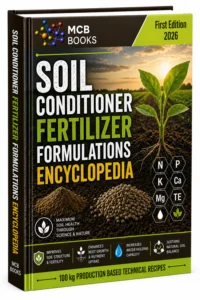
The SOIL CONDITIONER FERTILIZER FORMULATIONS ENCYCLOPEDIA includes practical formulations based on 100 kg production quantities, along with raw material functions, manufacturing procedures, technical specifications and application information. These formulations provide a structured technical starting point for fertilizer manufacturers and agricultural input companies developing different soil-conditioning products.
By combining suitable raw materials with controlled manufacturing methods, producers can develop professional soil conditioner fertilizer formulations for soil structure improvement, water retention and root development. Such products can become an important part of modern soil-management programs designed to maintain productive root-zone conditions and support sustainable agricultural production.