 The production of organic and mineral soil conditioner fertilizers requires careful control of formulation, raw material compatibility and manufacturing conditions. Unlike simple fertilizer blends, soil conditioners may contain a combination of humic substances, organic matter, mineral components, calcium sources, gypsum, biochar, micronutrients and functional additives. For this reason, manufacturers must select the correct production method according to the physical form and intended use of the final product.
One of the most important stages in soil conditioner fertilizer production is mixing. Liquid formulations generally begin with the addition of water to a suitable mixing tank, followed by gradual incorporation of soluble raw materials under continuous agitation. Humic acid, fulvic acid, organic extracts, mineral salts and other ingredients should be added in a controlled sequence to reduce the risk of precipitation, excessive viscosity or incomplete dispersion. Mixing speed and duration must also be adjusted according to the formulation.
For powder and granular products, dry blending is commonly used to distribute raw materials uniformly before further processing. Particle size should be controlled because large differences between individual ingredients can cause segregation during handling and storage. When producing granular soil conditioner fertilizers, the blended material may undergo granulation using suitable binders and moisture levels. The granules are then dried, screened and classified to obtain a consistent particle-size distribution.
pH control is particularly important in liquid and suspension soil conditioner formulations. Changes in pH can affect raw material solubility, chemical compatibility, viscosity and storage stability. Humic substances, mineral components and micronutrients may behave differently under acidic or alkaline conditions. Producers should therefore monitor pH throughout manufacturing and use appropriate pH regulators when necessary.
Suspension stability is another critical factor. Products containing gypsum, calcium compounds, biochar particles or other insoluble materials can develop sediment during storage if particle size and suspension systems are not properly controlled. Dispersing agents, suspending agents and stabilizers may be required to maintain a homogeneous product and improve redispersibility.
In granular production, drying and moisture control directly affect product strength and storage performance. Excess moisture can cause caking, microbial deterioration or poor flowability, while excessive drying may increase dust formation and granule breakage. Screening and coating processes can further improve uniformity, appearance and handling characteristics.
Finished products should undergo quality-control tests appropriate to their form. These may include pH, density, viscosity, moisture content, particle size, appearance, sedimentation, dispersibility and storage stability. Proper quality control helps manufacturers maintain consistency between different production batches.
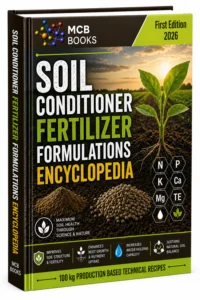
The SOIL CONDITIONER FERTILIZER FORMULATIONS ENCYCLOPEDIA provides practical 100 kg production formulations, together with raw material functions, manufacturing procedures, product specifications and technical information. It offers a structured reference for fertilizer manufacturers and agricultural input companies seeking to develop professional liquid, suspension, powder and granular soil conditioner products.
Understanding mixing, granulation, pH control and stability is essential for transforming a formulation into a commercially reliable soil conditioner. Correct manufacturing practices help producers achieve homogeneous, stable and scalable products suitable for modern agricultural markets.