 Maintaining adequate organic matter and nutrient availability is essential for productive agricultural soils. Intensive cultivation, erosion, repeated tillage and limited organic inputs can gradually reduce soil fertility and weaken the physical structure of the root zone. For this reason, soil conditioner fertilizers are widely used to improve soil conditions, support nutrient efficiency and create a more favorable environment for healthy plant development.
One of the primary objectives of a soil conditioner is to support soil organic matter improvement. Organic matter plays an important role in soil aggregation, water-holding capacity, biological activity and nutrient retention. Soil conditioner formulations may contain humic acid, fulvic acid, compost-derived materials, biochar, organic carbon sources and other processed organic components designed to increase the functional organic fraction of the soil.
Humic acid and fulvic acid are particularly important ingredients in many soil conditioner fertilizer formulations. Humic substances can interact with soil particles and contribute to improved cation exchange capacity, allowing the soil to retain certain nutrients more effectively. Fulvic acid, because of its relatively high solubility, can support nutrient mobility and may help improve the availability of mineral elements within the active root zone.
Soil conditioners may also include calcium, magnesium, sulfur and selected micronutrients such as iron, zinc, manganese and boron. When these materials are incorporated into a balanced formulation, soil-conditioning products can combine physical soil improvement with nutritional support. However, nutrient composition should always be designed according to the intended product function, soil characteristics and agricultural application.
Another important factor is the relationship between soil structure and nutrient efficiency. Poorly aggregated or compacted soils can restrict root growth, water movement and aeration. By improving soil structure and root-zone conditions, properly formulated soil conditioners can help plants explore a larger soil volume and make more efficient use of available nutrients.
Different product forms can be developed for specific agricultural systems. Liquid soil conditioners are commonly designed for fertigation, drip irrigation and soil-directed applications, while granular and powder products may be incorporated into the soil before planting or during field preparation. Suspension formulations can also be developed when the product contains insoluble or partially soluble mineral materials.
Manufacturing these products requires careful control of raw material compatibility, pH, particle size, mixing sequence, viscosity and storage stability. Organic and mineral ingredients must be selected carefully to prevent precipitation, excessive sedimentation or undesirable interactions during production and storage.
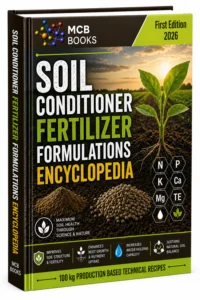
The SOIL CONDITIONER FERTILIZER FORMULATIONS ENCYCLOPEDIA provides practical formulations based on 100 kg production quantities, together with raw material functions, manufacturing methods, technical specifications and application guidance. These formulations offer a structured starting point for laboratory development, pilot production and commercial manufacturing.
For fertilizer manufacturers and agricultural input companies, developing soil conditioner fertilizers for increasing organic matter, nutrient availability and soil fertility represents an important opportunity within modern agriculture. With suitable formulation strategies, producers can create professional products designed to improve soil quality, support nutrient-use efficiency and contribute to long-term agricultural productivity.