 Professional skin care manufacturing requires accurate formulation ratios, suitable raw material selection and controlled production procedures. For cosmetic manufacturers and product developers, 100 kg medical and dermocosmetic skin care formulas provide a practical production basis because ingredient quantities can be clearly evaluated, tested and adapted to larger industrial manufacturing systems.
Dermocosmetic products may be developed in many different forms, including creams, lotions, serums, gels, cleansers, masks and specialized treatment-oriented skin care products. Each product type has a different technical structure and therefore requires a specific balance of active ingredients, functional additives and processing conditions.
A professional formulation may include ingredients such as hyaluronic acid, niacinamide, panthenol, ceramides, peptides, vitamins, antioxidants, botanical extracts, humectants and emollients. Depending on the product form, emulsifiers, surfactants, thickeners, rheology modifiers, preservatives, chelating agents and pH regulators may also be required.
Using a 100 kg production formula makes formulation calculations easier and more transparent. In a 100 kg batch, each kilogram of an ingredient corresponds approximately to one percent of the total formulation. This allows manufacturers to understand ingredient ratios quickly and provides a convenient reference point for pilot and commercial production planning.
However, successful scale-up requires more than multiplying ingredient quantities. Mixing efficiency, homogenization, heating and cooling times, raw material addition order and shear conditions may change significantly when production moves from laboratory scale to industrial tanks. These factors must be optimized to maintain product texture, viscosity and stability.
Cream and lotion formulations require particular attention to oil and water phase balance. The phases may need to be heated separately and combined under controlled emulsification conditions. Serums and gels require correct dispersion of polymers and water-soluble active ingredients to prevent clumping, precipitation or uneven texture.
Quality control is another essential part of industrial dermocosmetic production. Finished products may be evaluated for appearance, odor, color, pH, viscosity, density, homogeneity and storage stability. Packaging compatibility and long-term stability should also be considered before commercial release.
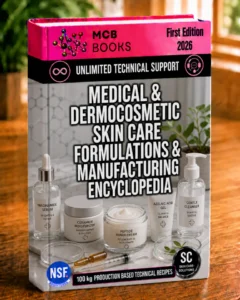
The MEDICAL & DERMOCOSMETIC SKIN CARE FORMULATIONS & MANUFACTURING ENCYCLOPEDIA provides practical formulations based on 100 kg manufacturing quantities, together with raw material functions, production procedures, technical specifications and product characteristics.
For cosmetic manufacturers, formulation specialists, private-label producers and entrepreneurs, standardized 100 kg skin care formulas offer a practical foundation for professional product development. The encyclopedia helps manufacturers move from formulation planning to pilot trials and industrial production with a more organized and technically structured approach.