The quality and performance of professional skin care products depend heavily on the correct selection of raw materials. In medical and dermocosmetic skin care formulations, each ingredient must perform a defined technical or cosmetic function while remaining compatible with the rest of the formulation. Understanding the role of active ingredients, emulsifiers, humectants, emollients, thickeners and preservation systems is therefore essential for successful product development.
Humectants are among the most important ingredients in skin care products because they help attract and retain moisture in the upper layers of the skin. Common examples include glycerin, propylene glycol, sorbitol and hyaluronic acid. These materials are widely used in creams, lotions, serums and gels designed for hydration and skin comfort.
Emollients and oils contribute to softness, smoothness and improved sensory properties. Cosmetic oils, esters, fatty alcohols, silicones and other conditioning materials may be selected according to the desired texture and skin feel. The choice of emollient can strongly influence spreadability, absorption and the final appearance of the product.
Active ingredients are used to provide targeted cosmetic benefits. Niacinamide, panthenol, ceramides, peptides, vitamins, antioxidants, botanical extracts and other functional materials may be incorporated into formulations developed for hydration, barrier support, uneven skin tone, visible signs of aging or general skin conditioning.
In cream and lotion formulations, emulsifiers are essential for combining the oil and water phases into a stable system. Co-emulsifiers and fatty alcohols may also be used to improve viscosity, texture and long-term stability. The correct emulsifier system should be selected according to the oil phase, active ingredients and target product characteristics.
Thickeners and rheology modifiers help control viscosity and product flow. Carbomers, cellulose derivatives, gums and other polymers can be used in gels, serums, creams and lotions. Their performance can be affected by pH, electrolytes and the presence of other ingredients, so compatibility must be evaluated carefully.
Preservation is another critical part of professional formulation. Preservatives, chelating agents and pH regulators help maintain microbiological and physicochemical stability during storage and use. The preservation system must be suitable for the product type, water activity, packaging and overall formulation environment.
Surfactants may also be required in cleansers, foaming products and certain emulsified systems. Their selection influences cleansing performance, foam quality and skin feel. Mild surfactant combinations are often preferred in dermocosmetic products developed for sensitive or frequently cleansed skin.
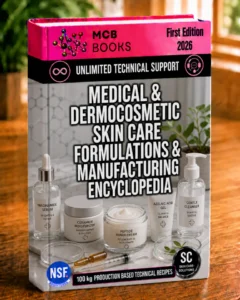
The MEDICAL & DERMOCOSMETIC SKIN CARE FORMULATIONS & MANUFACTURING ENCYCLOPEDIA provides practical information about raw materials used in professional skin care formulations, including their functions, quantities and roles in different product types. The formulations are structured around 100 kg production quantities, helping manufacturers understand ingredient ratios and manufacturing requirements.
For cosmetic manufacturers, private-label producers and formulation specialists, detailed knowledge of skin care raw materials and their functions is fundamental to developing stable, effective and commercially competitive dermocosmetic products.