1-Naphthaleneacetic acid (NAA) is a synthetic auxin-type plant growth regulator widely used in agriculture, horticulture and nursery production. It is applied for specific physiological purposes such as promoting adventitious root formation, improving fruit set under suitable conditions, regulating fruit thinning, reducing premature fruit drop and influencing plant growth responses. Because NAA activity depends strongly on concentration, formulation type, crop species and application timing, the development of stable and accurately dosed commercial products requires careful formulation and manufacturing control.
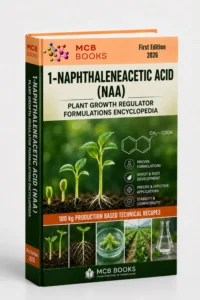
The 1-NAPHTHALENEACETIC ACID (NAA) PLANT GROWTH REGULATOR FORMULATIONS ENCYCLOPEDIA provides technical guidance for the development and production of NAA-based plant growth regulator products. It covers formulation concepts, raw material selection, production methods, product stability, application considerations and commercial manufacturing principles for different NAA formulations.
NAA has relatively limited solubility in water in its free-acid form, so formulators may use suitable solvents, neutralizing agents, surfactants or soluble NAA salts depending on the intended product type. Commercial NAA formulations can be developed as soluble concentrates, liquid concentrates, emulsifiable systems, wettable powders, soluble powders or combination formulations. The formulation system must maintain uniform active ingredient distribution and prevent crystallization, sedimentation or instability during storage.
Raw materials used in NAA formulations may include solvents, co-solvents, emulsifiers, wetting agents, dispersing agents, stabilizers, buffers, carriers, antifoaming agents and preservatives where appropriate. Their selection depends on the formulation type and intended application method. Compatibility testing is essential because unsuitable ingredients can affect NAA solubility, chemical stability or product performance.
Commercial manufacturing generally begins with preparation of the solvent or aqueous phase. NAA is then dissolved or dispersed under controlled mixing conditions. Other formulation auxiliaries are added gradually, followed by pH adjustment, homogenization and final volume or weight correction. Temperature should be controlled during manufacturing to prevent unnecessary degradation and ensure reproducible batch quality.
NAA-based plant growth regulators are used in several agricultural applications. In rooting products, NAA can stimulate the formation of adventitious roots in cuttings and young plants. In fruit crops, carefully selected application rates may be used for fruit thinning, fruit retention or reduction of premature fruit drop. Application concentration and timing are critical because excessive doses may cause undesirable plant responses.
Quality control is therefore an important part of commercial NAA production. Finished products may be evaluated for active ingredient concentration, pH, density, appearance, solubility, viscosity, storage stability and packaging compatibility. Accelerated and long-term stability studies are also useful for defining suitable shelf life.
By combining correct formulation design, compatible raw materials and controlled manufacturing methods, manufacturers can produce reliable NAA plant growth regulator products for professional agricultural applications. Proper formulation and accurate application help ensure consistent plant response while supporting efficient and commercially practical production.