24-Epibrassinolide is a highly active brassinosteroid plant growth regulator widely studied and used in modern agriculture for supporting plant development, improving tolerance to environmental stress, enhancing flowering and fruit development, and increasing crop productivity. Because it is biologically active at extremely low concentrations, successful commercial products require carefully designed formulations that provide accurate dosing, good solubility, stability, and uniform distribution during agricultural application.
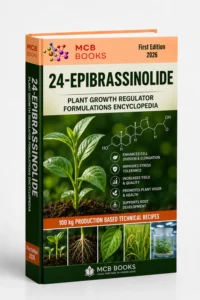
The 24-EPIBRASSINOLIDE PLANT GROWTH REGULATOR FORMULATIONS ENCYCLOPEDIA provides practical technical information for professionals who want to understand the formulation, production, and agricultural application of 24-epibrassinolide-based plant growth regulator products. Formulation technology is particularly important because pure 24-epibrassinolide has limited water solubility and must generally be incorporated into suitable solvent, emulsifier, surfactant, carrier, or dispersion systems before it can be effectively applied to crops.
Commercial formulations may be produced as soluble concentrates, emulsifiable concentrates, liquid concentrates, suspension-type products, or other specialized agricultural preparations. The selection of solvents, wetting agents, emulsifiers, stabilizers, preservatives, pH regulators, and supporting ingredients directly influences product stability and field performance. During manufacturing, controlled mixing, complete dissolution or dispersion of the active ingredient, pH adjustment, filtration, homogenization, and final quality control are essential steps.
24-Epibrassinolide formulations can be developed for a wide range of agricultural applications. Depending on crop type, growth stage, concentration, and application method, they may be used to support seed germination, root development, vegetative growth, flowering, fruit setting, fruit enlargement, and overall crop quality. The compound is also frequently associated with improved plant responses to drought, salinity, temperature fluctuations, transplant shock, and other forms of abiotic stress.
Foliar spraying is one of the most common application methods because very low concentrations of 24-epibrassinolide can be distributed efficiently over leaf surfaces. Certain formulations may also be adapted for seed treatment, seedling applications, root-zone treatments, or integration into professional crop management programs. Correct dosage is extremely important because plant growth regulators are physiologically active substances and excessive concentrations do not necessarily improve performance.
For commercial manufacturers, product consistency is equally important. Quality control may include assessment of appearance, active ingredient concentration, pH, density, solubility or dispersibility, storage stability, low-temperature stability, and compatibility with water used for dilution. Packaging materials should also be selected to protect the formulation from light, heat, moisture, and contamination.
Professional 24-epibrassinolide formulation technology combines plant physiology, agricultural chemistry, raw material selection, manufacturing control, and field application knowledge. Well-designed products can provide reliable performance while allowing growers to use extremely small quantities of active ingredient efficiently. For manufacturers, formulators, agricultural technicians, and crop-production professionals, understanding these principles is fundamental to developing stable, effective, and commercially viable 24-epibrassinolide plant growth regulator products.