Ethephon is an important ethylene-releasing plant growth regulator used in professional agriculture and horticulture for several crop-management purposes. Depending on the crop, variety, growth stage, and approved local use pattern, ethephon may be used for flowering induction, fruit ripening, color development, maturation management, harvest synchronization, and other physiological responses. Developing 100 kg ethephon plant growth regulator formulas requires careful selection of the active ingredient concentration, carrier system, stabilizing components, pH-control materials, surfactants, and other formulation auxiliaries.
A commercial 100 kg ethephon formulation is generally based on ethephon as the principal active ingredient together with a compatible liquid carrier and supporting raw materials. These may include purified or deionized water, suitable solvents or co-solvents, wetting agents, surfactants, buffering components, chelating agents, stabilizers, antifoaming agents, preservatives, and other formulation aids. The exact composition depends on the desired concentration, application method, storage requirements, and regulatory specifications of the target market.
Formulations intended for flowering management are designed to provide uniform application and predictable plant response under approved agricultural programs. In selected crops, ethephon can influence flowering behavior through its ethylene-releasing action. Correct formulation quality is important because uneven dilution or poor spray coverage may lead to inconsistent results.
For fruit ripening and fruit color development, ethephon formulations may be used to help coordinate maturation and improve uniformity where permitted. These applications can be particularly valuable in commercial crop systems where synchronized ripening or improved market appearance is important. However, crop response depends strongly on application timing, temperature, plant condition, variety, and dose.
Ethephon may also be incorporated into harvest-management programs to help synchronize crop maturity and simplify harvesting operations. A properly designed formulation should provide good dilution behavior, stable active ingredient content, consistent spray characteristics, and suitable compatibility with standard agricultural application equipment.
Commercial manufacturing of a 100 kg batch normally begins with preparation of the liquid carrier phase under controlled agitation. Functional auxiliaries are introduced in the required sequence, followed by the active ingredient and remaining formulation components. Special attention must be given to pH because ethephon stability is highly dependent on the chemical environment. The batch is then adjusted to final weight, homogenized, and filtered where required before packaging.
Quality-control testing may include active ingredient concentration, appearance, pH, density, dilution characteristics, physical stability, storage stability, and packaging compatibility. Batch-to-batch consistency is essential for commercial plant growth regulator products.
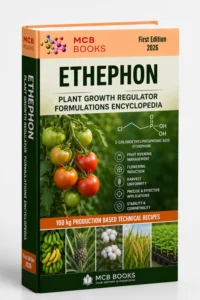
The ETHEPHON PLANT GROWTH REGULATOR FORMULATIONS ENCYCLOPEDIA provides practical technical information on 100 kg formulation concepts, raw-material functions, production methods, application considerations, quality control, and commercial manufacturing. It is designed as a useful reference for agrochemical manufacturers, formulation specialists, horticultural professionals, agricultural consultants, and companies developing ethephon-based plant growth regulator products.
All ethephon products must be manufactured, registered, labeled, and used according to the approved crop uses, application rates, residue requirements, worker-safety standards, and agricultural regulations of the country in which they are marketed.