Forchlorfenuron, commonly known as CPPU, is an important synthetic plant growth regulator used in professional agriculture to influence cell division, fruit development, fruit enlargement, fruit setting, and overall fruit quality. Commercial CPPU products must be carefully formulated to provide uniform active ingredient distribution, good dilution characteristics, adequate storage stability, and reliable performance under field conditions. For manufacturers, 100 kg CPPU plant growth regulator formulas provide a practical production basis for developing different commercial product types.
A typical 100 kg CPPU formulation may contain Forchlorfenuron as the active ingredient, together with appropriate solvents or carriers, surfactants, wetting agents, dispersing agents, emulsifiers, stabilizers, rheology modifiers, preservatives, antifoaming agents, and pH-adjusting materials. The exact formulation structure depends on the concentration of CPPU and whether the product is manufactured as a soluble concentrate, suspension concentrate, emulsifiable formulation, or another specialized agricultural delivery system.
One of the principal agricultural applications associated with CPPU is fruit enlargement. CPPU exhibits cytokinin-like activity and can stimulate cell division and subsequent fruit development when used appropriately. For this reason, CPPU-based products are used in crop-management programs where fruit size, uniformity, and commercial appearance are important production objectives.
Fruit setting and early fruit development are additional areas where carefully managed plant growth regulator programs may be used. Application timing is critical. The physiological response of a crop can vary considerably depending on the developmental stage, variety, concentration, environmental conditions, and other agricultural practices. Therefore, commercial formulations should be designed not only for chemical stability but also for accurate and uniform field dilution.
CPPU formulations may also contribute to programs focused on fruit quality and marketable yield. Depending on the crop and application program, the desired results may include larger fruit, improved uniformity, better fruit development, and increased commercial yield. However, excessive or incorrectly timed applications can negatively influence quality parameters, which makes precise dosage and application management essential.
During commercial production of a 100 kg batch, manufacturers must carefully control raw-material addition, agitation, dissolution or dispersion, homogenization, temperature, pH, and final batch adjustment. Suspension-based formulations may additionally require high-shear mixing or milling to obtain suitable particle distribution and long-term physical stability.
Quality-control testing is equally important. Finished products may be evaluated for active ingredient concentration, appearance, pH, density, viscosity, particle size, suspension or emulsion stability, dilution behavior, storage stability, and packaging compatibility before commercial release.
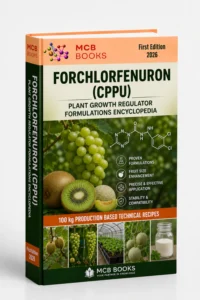
The FORCHLORFENURON (CPPU) PLANT GROWTH REGULATOR FORMULATIONS ENCYCLOPEDIA provides detailed technical information concerning formulation principles, 100 kg production concepts, raw-material functions, manufacturing processes, application considerations, and quality-control requirements. It can serve as a practical reference for agrochemical manufacturers, agricultural formulation specialists, researchers, consultants, and companies developing CPPU-based plant growth regulator products for professional agricultural markets.