 Bacillus thuringiensis (Bt) is one of the best-known microorganisms used in biological insect control and microbial biopesticide production. Bt-based products are widely associated with sustainable crop protection because selected strains can produce biologically active proteins that affect specific groups of insect pests. For manufacturers developing biological crop protection products, properly designed Bacillus thuringiensis biopesticide formulations are essential for maintaining microbial activity, storage stability, application performance, and commercial product quality.
Bt is a naturally occurring, spore-forming bacterium. During its biological development, certain strains produce insecticidal crystal proteins that can act against susceptible insect larvae. When a target insect consumes treated plant material, these proteins can become active in the insect digestive system, damaging the intestinal tissue and eventually resulting in insect mortality. Because different Bt strains and protein groups have activity against different pest species, strain selection is one of the most important steps in product development.
Commercial Bt biopesticide formulations may be produced in several forms, including suspension concentrates, liquid formulations, wettable powders, water-dispersible powders, granules, and other agricultural delivery systems. The most suitable formulation depends on the selected Bt strain, target insect, crop, application method, storage conditions, and required product shelf life.
The formulation does not consist only of the microbial active ingredient. A professional Bt biopesticide may also require carefully selected carriers, wetting agents, dispersing agents, suspending agents, stabilizers, protective materials, fillers, anti-caking agents, and other compatible formulation ingredients. These components help distribute the biological material uniformly while improving handling, dilution, spraying, and storage properties.
One of the most important challenges in Bacillus thuringiensis formulation technology is protecting the biological active material from unfavorable environmental conditions. Excessive moisture, unsuitable pH, high temperatures, ultraviolet radiation, and incompatible chemicals can reduce product performance. For this reason, stabilizing and protective ingredients may be included to support microbial viability and help preserve biological activity during storage and field application.
In liquid Bt formulations, manufacturers must pay particular attention to suspension stability. Microbial particles and other insoluble materials can settle during storage, so suitable rheology modifiers and suspending agents may be required. The product should be easy to redisperse and should remain compatible with standard agricultural spraying equipment.
For powdered Bt products, moisture control, particle size, wettability, dispersibility, and flow properties become especially important. The formulation should disperse efficiently when mixed with water and should not form excessive lumps or sediment. Proper packaging is also necessary to protect the product against humidity and temperature fluctuations.
The manufacturing process of Bt biopesticides generally involves microbial cultivation or fermentation, recovery of the biological material, concentration or processing, formulation, stabilization, homogenization, quality control, and packaging. Production conditions must be carefully controlled because inappropriate temperatures, excessive shear, contamination, or unsuitable processing conditions may negatively affect the biological component.
Quality control is a critical part of professional and industrial Bt biopesticide production. Important parameters may include microbial concentration, spore count, biological activity, purity, contamination control, moisture content, pH, suspension stability, dispersibility, particle characteristics, and storage stability. Consistent quality specifications help ensure that every manufactured batch performs within the intended technical range.
Bt products can be used as part of integrated pest management programs where biological, cultural, and other crop protection methods are combined. Because their activity is often highly dependent on the susceptible insect species and larval stage, correct application timing and proper coverage are important factors in achieving good field performance.
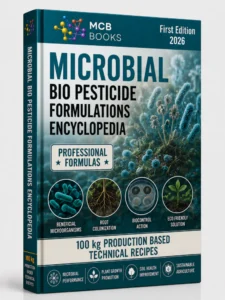
The MICROBIAL BIO PESTICIDE FORMULATIONS ENCYCLOPEDIA provides practical technical information for manufacturers interested in developing Bacillus thuringiensis and other microbial biopesticide products. It covers formulation principles, raw material functions, production methods, technical specifications, and commercial manufacturing considerations.
For biopesticide manufacturers, agricultural input companies, biological control product developers, R&D specialists, formulation experts, and entrepreneurs, understanding Bt formulation technology provides an important foundation for producing modern biological insect control products. Carefully designed Bacillus thuringiensis biopesticide formulations can help transform microbial active materials into stable, practical, and commercially applicable solutions for sustainable agricultural pest management.