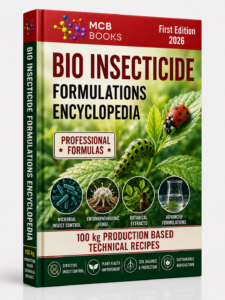
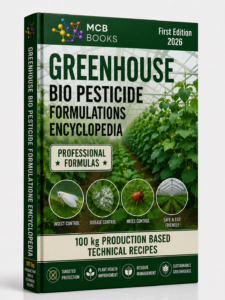
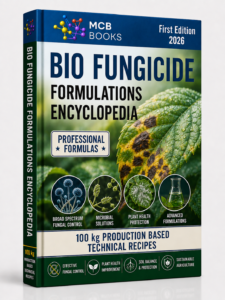
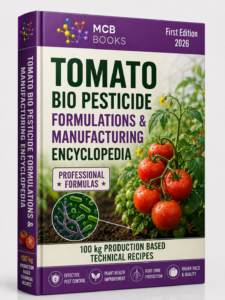
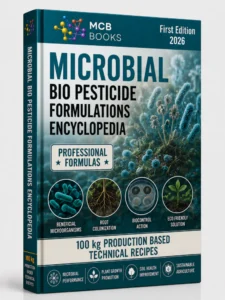
The performance of a microbial biopesticide depends not only on the selected microorganism but also on the raw materials used to protect, stabilize, disperse, and deliver that microorganism to the target crop or pest. In professional production, the correct combination of microbial active agents and formulation ingredients is essential for achieving acceptable viability, storage stability, dispersibility, application performance, and commercial product quality. The MICROBIAL BIO PESTICIDE FORMULATIONS ENCYCLOPEDIA provides practical information about the raw materials commonly used in microbial biopesticicide formulations and explains their functions in industrial production.
The most important component of any microbial biopesticide formulation is the active microbial agent. Depending on the intended biological control purpose, manufacturers may work with microorganisms such as Bacillus thuringiensis, Bacillus subtilis, Trichoderma species, Beauveria bassiana, Metarhizium species, and other beneficial microbial strains. These microorganisms may be incorporated as spores, cells, biomass, fermentation products, or other suitable biological preparations.
Carriers are another major group of raw materials used in microbial pesticide formulations. They provide a physical medium for distributing and protecting the microbial active ingredient. Mineral carriers, organic carriers, and other compatible materials may be selected according to whether the final product is produced as a powder, granule, suspension, or liquid formulation. An appropriate carrier should support homogeneous distribution and should not negatively affect microbial viability.
Fillers and bulking agents are commonly used in powder and granular microbial biopesticides. Their main function is to adjust product concentration, improve flow properties, facilitate accurate dosing, and provide the required final batch weight. The filler must be compatible with the microorganism and should have suitable moisture and particle-size characteristics.
Wetting agents help powder formulations become rapidly wetted when added to water. Without adequate wetting, the formulation may remain on the water surface or form floating particles. Good wetting performance makes agricultural dilution and tank preparation easier and contributes to more uniform field application.
Dispersing agents are used to keep particles separated after the product is mixed with water. They help reduce agglomeration and sediment formation and improve the distribution of the microbial component throughout the spray solution. This function is particularly important in wettable powders, water-dispersible products, and suspension-based formulations.
Suspending agents and rheology modifiers are especially important in liquid microbial biopesticide formulations. They help prevent rapid settling of microbial particles and other insoluble materials during storage. A properly designed suspension should remain sufficiently stable while still being easy to pour, dilute, and apply through agricultural spraying equipment.
Stabilizers and protective agents help preserve microbial viability during manufacturing, storage, transport, and application. Depending on the microorganism, formulations may require protection against moisture fluctuations, oxidation, temperature stress, ultraviolet radiation, or other environmental factors. Protective materials can therefore play an important role in maintaining biological activity until the product reaches the field.
Humectants and moisture-control ingredients may also be incorporated into some formulations. Their purpose is to regulate water activity and help maintain an environment that supports product stability without encouraging unwanted microbial contamination or excessive biological activity during storage.
In liquid products, pH-adjusting and buffering materials can be necessary because many microbial strains remain viable only within an appropriate pH range. Careful pH control can improve formulation stability and reduce undesirable changes during storage.
Other raw materials may include anti-caking agents, defoamers, adhesives, stickers, spreading agents, preservatives compatible with the biological system, and processing aids. Their use depends on the formulation type, production process, microorganism, target application, and required product characteristics.
Raw material compatibility is one of the most critical aspects of microbial biopesticide development. Ingredients that perform well in conventional chemical pesticides may not always be suitable for living microbial formulations. Every component must therefore be evaluated for its effect on microbial viability, formulation stability, physical properties, and field performance.
The MICROBIAL BIO PESTICIDE FORMULATIONS ENCYCLOPEDIA brings together information on microbial active ingredients, carriers, fillers, wetting agents, dispersants, stabilizers, suspending agents, protective materials, and other formulation components. It is designed for biopesticide manufacturers, agricultural input companies, R&D specialists, formulation developers, entrepreneurs, and industrial producers seeking practical knowledge for developing reliable microbial crop protection products.
Understanding the functions of raw materials is a fundamental step in producing stable and commercially successful microbial biopesticides. Correct ingredient selection allows manufacturers to transform sensitive biological microorganisms into practical agricultural products suitable for professional and industrial use.