Flower Induction Chemicals:
Complete Formulation & Production Guide
 In crop production, timing is everything—especially when it comes to flowering. If plants enter the flowering stage too early, too late, or unevenly, it directly affects yield and product quality. This is why flower induction chemicals have become an essential part of modern agriculture. These formulations are designed to trigger and regulate the flowering process, helping plants respond more predictably under varying environmental conditions.
At the core of flower induction systems are plant growth regulators such as gibberellins, cytokinins, and sometimes auxins. Gibberellins are widely used to initiate flowering in crops that require stimulation, particularly under suboptimal conditions. Cytokinins contribute to better flower formation and support overall plant vitality, while auxins help maintain growth balance and improve the effectiveness of the formulation when used in controlled amounts.
However, the performance of a flower induction product is not determined by active ingredients alone. A successful formulation also depends on how these components are combined and delivered. Solvents are used to dissolve hormone-based actives that are not easily soluble in water. Surfactants improve the spreading and absorption of the product on plant surfaces, ensuring that the active ingredients are effectively taken up. Stabilizers protect sensitive compounds from degradation, while in some cases, chelating agents are included to enhance compatibility and performance in different water conditions.
The production process of flower induction chemicals follows a structured and controlled approach. First, the active ingredients are dissolved in a suitable solvent system under controlled temperature conditions. This ensures complete solubility and stability. Next, surfactants are added gradually while maintaining continuous mixing to achieve a homogeneous solution. Stabilizers and other supporting components are then introduced to enhance shelf life and formulation robustness.
After mixing, the pH of the formulation is carefully adjusted. This step is critical because plant hormones are often sensitive to pH fluctuations, and maintaining the correct range ensures both storage stability and field performance. Once the desired pH is achieved, the formulation is filtered to remove any undissolved particles and then transferred into appropriate packaging for commercial distribution.
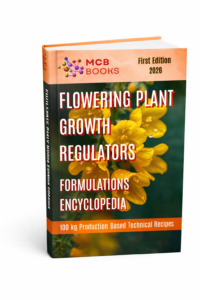
For producers, achieving a stable and effective formulation can be challenging. Small variations in ingredient ratios or processing conditions can significantly impact the final product. This is why many professionals prefer to work with proven systems instead of relying entirely on trial and error. The FLOWERING PLANT GROWTH REGULATORS FORMULATIONS ENCYCLOPEDIA provides ready-to-use formulations, optimized ingredient systems, and detailed production insights that help reduce development time and improve product reliability.
In the end, flower induction is not just about triggering blooms—it’s about doing it in a controlled, consistent, and efficient way. With the right formulation and production process, growers can achieve better flowering performance and higher crop yields.