 Chlormequat chloride is an important plant growth regulator widely used to control excessive vegetative growth, reduce plant height, strengthen stems and improve crop architecture. It is particularly associated with cereal production, ornamental crops and other agricultural systems where excessive stem elongation can increase lodging risk or reduce plant compactness. The commercial manufacture of chlormequat chloride plant growth regulators requires appropriate formulation design, carefully selected raw materials and standardized processing methods to obtain a stable and uniform finished product.
The first stage of production is determining the required formulation type and active ingredient concentration. Chlormequat chloride is highly compatible with aqueous systems, so commercial products are frequently manufactured as water-soluble liquid concentrates. The selected formulation should take into account the target crop, intended application method, required dilution rate, storage conditions and desired physical characteristics of the finished product.
Raw material selection is a key part of formulation development. In addition to chlormequat chloride as the active ingredient, formulations may contain purified or deionized water, surfactants, wetting agents, stabilizers, buffering agents, preservatives, antifoaming agents and other functional ingredients. These materials help maintain product homogeneity, improve spray distribution, control pH and support long-term storage stability.
Commercial manufacturing generally starts by charging a predetermined quantity of water into a clean stainless-steel production vessel and beginning moderate agitation. Chlormequat chloride is then gradually added while mixing continues until the active ingredient is completely dissolved and the solution becomes uniform. The rate of addition should be controlled to prevent localized concentration differences and excessive foaming.
After dissolution of the active ingredient, the required surfactants, wetting agents and stabilizers are added sequentially. If buffering agents or pH regulators are included, they are normally incorporated after the principal components have been dissolved. The formulation is then mixed until complete homogeneity is achieved. Processing temperature should be controlled according to the stability requirements of the active ingredient and auxiliary materials.
pH is an important quality parameter for aqueous chlormequat chloride formulations. The finished product should remain within the predetermined specification range to help maintain chemical stability and compatibility with other formulation ingredients. Suitable acids, alkalis or buffer systems may therefore be used for controlled pH adjustment.
Once mixing is completed, the formulation may be filtered to remove foreign particles or manufacturing residues before packaging. The product is then transferred into compatible containers that provide protection from contamination, moisture loss and unsuitable storage conditions.
Quality-control testing is essential before commercial release. Typical parameters include appearance, active ingredient concentration, pH, density, solubility, clarity, physical stability and storage behavior. Accelerated stability testing can also be used to evaluate potential changes during storage and to support shelf-life determination.
Large-scale manufacturing requires strict batch standardization. Raw material quality, mixing speed, addition sequence, processing time, temperature and final adjustment procedures should remain consistent from one production batch to another.
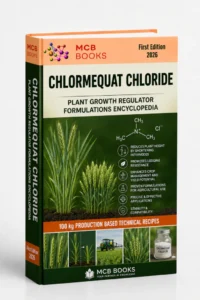
The CHLORMEQUAT CHLORIDE PLANT GROWTH REGULATOR FORMULATIONS ENCYCLOPEDIA provides manufacturers, formulators and agricultural professionals with structured technical information on raw materials, formulation principles and commercial production methods. With suitable formulation design and controlled manufacturing procedures, chlormequat chloride can be produced as a stable and practical plant growth regulator for professional agricultural applications.