Granular NPK fertilizers are among the most widely used agricultural inputs due to their ease of application, balanced nutrient delivery, and long shelf life. For manufacturers and entrepreneurs aiming to enter the fertilizer industry, understanding the industrial formulation and production process of granular NPK fertilizers is essential. This guide explains the key stages, raw materials, and formulation principles behind high-quality NPK granules.
At its core, NPK fertilizer production is based on combining three primary nutrients: nitrogen (N), phosphorus (P), and potassium (K). These nutrients are typically supplied through raw materials such as urea or ammonium sulfate for nitrogen, monoammonium phosphate (MAP) or phosphoric acid for phosphorus, and potassium chloride (MOP) or potassium sulfate (SOP) for potassium. The selection of raw materials directly affects the final product’s solubility, granule strength, and agronomic efficiency.
The industrial production of granular NPK fertilizers generally involves a granulation process, where fine powders are converted into uniform granules. One of the most common methods is drum granulation. In this process, raw materials are precisely weighed according to the target NPK ratio (such as 15-15-15 or 20-10-10) and then fed into a rotating drum granulator. A liquid binder—often water, steam, or a solution containing ammonium salts—is added to facilitate particle adhesion and granule formation.
During granulation, small particles collide and stick together, gradually forming larger granules. Process control is critical at this stage. Parameters such as moisture content, temperature, and drum rotation speed must be carefully optimized to ensure consistent granule size and prevent excessive dust formation. High-quality granules typically range between 2–5 mm in diameter, which is ideal for mechanical spreading in agricultural fields.
After granulation, the product is transferred to a drying unit. Drying reduces the moisture content to a stable level, usually below 2–3%, which is essential for preventing caking and ensuring long-term storage stability. Rotary dryers are commonly used in industrial plants, where hot air removes excess moisture without degrading the nutrients.
The dried granules then pass through a screening system. Oversized granules are crushed and recycled back into the process, while undersized particles are returned to the granulator. This closed-loop system improves production efficiency and minimizes raw material loss. The properly sized granules are then cooled using air coolers to enhance their mechanical strength and prevent condensation during storage.
To further improve product quality, manufacturers often apply a coating step. Anti-caking agents and surface conditioners are sprayed onto the granules to prevent sticking during storage and transportation. In some cases, micronutrients such as zinc, boron, or iron are also added to create value-added fertilizer products tailored for specific crops.
Quality control is a crucial part of the manufacturing process. Parameters such as nutrient content, granule size distribution, hardness, and moisture level must be continuously monitored. Consistency in these properties ensures that farmers receive a reliable product that delivers predictable crop performance.
In today’s competitive fertilizer market, developing optimized and cost-effective formulations is just as important as mastering the production process. Manufacturers must balance raw material costs, nutrient efficiency, and product performance to remain competitive.
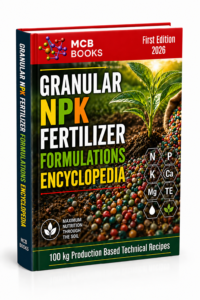
For professionals looking to go beyond basic production knowledge and access real industrial-scale formulations, the Granular NPK Fertilizer Formulations Encyclopedia provides detailed 100 kg production recipes, raw material specifications, and step-by-step manufacturing processes. It is an essential resource for anyone aiming to produce high-quality granular fertilizers at a commercial level.