Granular NPK fertilizer production is an important industrial process for manufacturers who want to produce balanced, stable, and easy-to-apply fertilizer products for modern agriculture. NPK fertilizers contain three essential nutrients: nitrogen, phosphorus, and potassium. These nutrients support plant growth, root development, flowering, fruit formation, and overall crop productivity. For this reason, granular NPK fertilizers are widely used in field crops, vegetables, fruits, orchards, and commercial farming systems.
The production process starts with selecting the correct raw materials. Nitrogen sources may include urea, ammonium sulfate, or ammonium chloride. Phosphorus can be supplied by monoammonium phosphate, diammonium phosphate, or phosphate-based materials. Potassium is commonly supplied through potassium chloride or potassium sulfate. The raw material selection depends on the target formula, crop requirement, solubility, cost, and final nutrient ratio.
A typical complete formula may be designed according to ratios such as 15-15-15, 20-10-10, 12-12-17, or 10-20-20. In industrial production, each ingredient is weighed carefully to achieve the desired nutrient balance. Accuracy at this stage is very important because even small errors can change the final NPK analysis and reduce product quality.
After weighing, the raw materials are transferred into a mixer. The purpose of mixing is to create a homogeneous powder blend before granulation. A uniform mixture helps every granule contain a balanced nutrient profile. Poor mixing can cause uneven nutrient distribution, dusty products, weak granules, and inconsistent performance in the field.
The next step is granulation. In many industrial systems, drum granulators, pan granulators, or compaction granulators are used. During this stage, the powder mixture is converted into granules by adding moisture, binder, steam, or a suitable granulation liquid. The particles begin to stick together and gradually form round or irregular granules. Moisture level, residence time, rotation speed, and binder amount must be controlled carefully to obtain strong and uniform granules.
After granulation, the wet granules are sent to a dryer. Drying removes excess moisture and improves storage stability. If the fertilizer remains too wet, it may cake, stick, or break down during storage. If it is over-dried, granules may become fragile and dusty. Therefore, drying temperature and time must be balanced according to the raw material system and granule size.
The dried granules then pass through a screening unit. Properly sized granules are separated from oversized and undersized materials. Oversized granules are crushed and recycled, while fine particles are returned to the granulation stage. This recycling system improves efficiency and helps maintain a consistent granule size, usually between 2–5 mm for agricultural application.
Cooling is another important step. Hot granules must be cooled before packaging to prevent condensation and caking inside bags. After cooling, anti-caking agents or coating materials can be applied to improve flowability, reduce dust, and increase shelf life.
Quality control should be performed throughout the production process. Manufacturers should check nutrient content, moisture level, granule hardness, particle size distribution, pH, bulk density, and storage behavior. These tests help ensure that the final fertilizer is suitable for commercial sale and agricultural use.
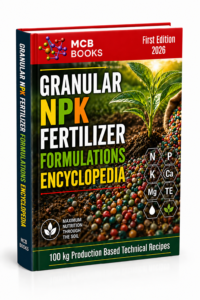
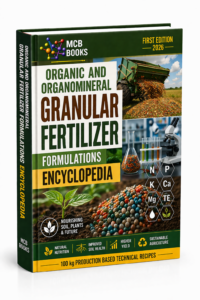
For producers who want detailed industrial recipes, raw material amounts, and professional manufacturing methods, the Granular NPK Fertilizer Formulations Encyclopedia provides complete 100 kg production-based formulations and step-by-step production processes. It is a valuable technical resource for fertilizer manufacturers, entrepreneurs, and agricultural product developers who want to produce high-quality granular NPK fertilizers for commercial markets.