 Liquid organic fertilizers are increasingly used in commercial agriculture because they can provide flexible plant nutrition for foliar spraying, fertigation, soil application, and root-zone treatment. These products can be formulated to support root development, nutrient uptake, vegetative growth, flowering, fruit production, soil fertility, and overall crop performance. For fertilizer manufacturers, understanding how to manufacture liquid organic fertilizers is essential for developing stable, consistent, and commercially viable agricultural products.
The first stage of liquid organic fertilizer manufacturing is selecting suitable raw materials. Common ingredients may include humic acid, fulvic acid, amino acids, protein hydrolysates, seaweed extracts, organic nitrogen sources, potassium compounds, micronutrients, organic acids, stabilizers, preservatives, and water. The exact formulation depends on the intended application, crop type, nutrient profile, product concentration, and desired technical characteristics.
Raw material quality is especially important in commercial organic fertilizer production. Ingredients should be evaluated for solubility, concentration, pH, purity, compatibility, and storage behavior. Humic substances may influence viscosity and sediment formation, while micronutrients can interact with organic components and cause precipitation if the formulation is not properly designed. Amino acids and seaweed extracts should also be selected according to their concentration, solubility, and compatibility with the other ingredients.
The manufacturing process generally begins by adding a calculated amount of water to a suitable mixing tank. Liquid or water-soluble organic ingredients are then introduced gradually under controlled agitation. Humic acid, fulvic acid, amino acids, seaweed extracts, nutrients, and functional additives can be incorporated according to the production formula. The order of addition is important because improper mixing can result in precipitation, phase separation, excessive viscosity, or poor product stability.
pH control is another essential part of liquid organic fertilizer production. The pH can influence nutrient solubility, raw material compatibility, preservative performance, and long-term storage stability. Mixing temperature, agitation speed, processing time, density, viscosity, and final product appearance should also be monitored throughout manufacturing.
Commercial liquid organic fertilizers can be developed for different application methods. Foliar formulations should provide good solubility and spreading on plant surfaces, while fertigation products should remain stable and sufficiently soluble to minimize sediment formation or irrigation-system blockage. Soil-applied products can be designed to support root-zone nutrition, soil conditioning, and nutrient availability.
Quality control should be completed before commercial packaging. Important parameters may include appearance, pH, density, viscosity, nutrient content, organic matter, solubility, sediment formation, storage stability, and packaging compatibility.
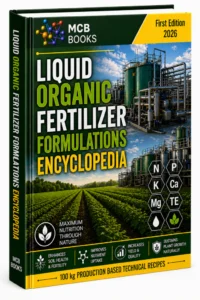
The LIQUID ORGANIC FERTILIZER FORMULATIONS ENCYCLOPEDIA provides practical technical information about liquid organic fertilizer formulations, raw materials, production methods, manufacturing procedures, quality control, and commercial product development. It is a useful reference for fertilizer manufacturers, formulators, agricultural companies, and entrepreneurs seeking professional knowledge about commercial liquid organic fertilizer production.