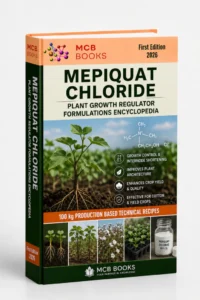
 Mepiquat Chloride is an important plant growth regulator widely used in commercial agriculture to control excessive vegetative growth, reduce internode elongation and promote a more compact plant structure. It is especially useful in crops where excessive stem and leaf growth can negatively affect canopy management, reproductive development and harvesting efficiency. Manufacturing reliable Mepiquat Chloride plant growth regulators requires a properly designed formulation, suitable raw materials, controlled production conditions and consistent quality control procedures.
The first stage of manufacturing is determining the required active ingredient concentration and the final product type. Mepiquat Chloride is highly compatible with aqueous formulation systems and is commonly manufactured as soluble concentrates or liquid concentrates. The exact formulation depends on the intended crop, application rate, dilution requirements, packaging system and commercial specifications of the final product.
Typical raw materials used in Mepiquat Chloride formulations may include Mepiquat Chloride as the active ingredient, purified or deionized water, surfactants, wetting agents, stabilizers, buffering agents, preservatives, antifoaming agents and other formulation auxiliaries. Depending on the desired product characteristics, humectants or compatibility-enhancing ingredients may also be incorporated. Each component should be selected according to its compatibility with the active ingredient and its contribution to long-term formulation stability.
Commercial manufacturing generally starts by charging a calculated quantity of purified or deionized water into a clean stainless-steel mixing vessel. Moderate agitation is started, and selected buffering agents, stabilizers or other water-soluble auxiliaries are dissolved. Mepiquat Chloride is then introduced gradually while mixing continues until a completely homogeneous solution is obtained. Remaining surfactants, preservatives and other functional additives are incorporated according to the formulation design.
Process parameters such as temperature, mixing speed, pH and order of addition should be carefully controlled. Since soluble formulations depend on maintaining a clear and uniform solution, incomplete dissolution, contamination or unsuitable pH conditions can affect the physical quality and storage performance of the product. Excessive aeration should also be avoided during mixing, particularly when surfactants are present.
After all ingredients have been incorporated, the formulation may be adjusted to its final batch weight with purified water. The finished solution is mixed until completely uniform and, where required, passed through an appropriate filtration system before filling. Filtration can help remove unwanted particles and improve the appearance and consistency of the final commercial product.
Quality control is a critical part of Mepiquat Chloride manufacturing. Typical evaluations include active ingredient concentration, pH, density, appearance, color, homogeneity and solution stability. Accelerated storage, low-temperature stability and packaging compatibility may also be evaluated to confirm that the formulation remains stable throughout its expected shelf life.
Commercial packaging should protect the formulation against contamination, leakage and unsuitable storage conditions. Containers must be chemically compatible with the formulation and properly labeled according to applicable agricultural chemical regulations.
The MEPIQUAT CHLORIDE PLANT GROWTH REGULATOR FORMULATIONS ENCYCLOPEDIA provides practical technical information on formulation systems, raw material selection, manufacturing procedures and commercial production principles. Properly manufactured Mepiquat Chloride products can provide reliable solutions for plant height control, internode reduction, compact growth, canopy management and improved crop production efficiency.