Tag Archives: gypsum soil conditioner

COMMERCIAL SOIL CONDITIONER PRODUCTION WITH THE SOIL CONDITIONER FERTILIZER FORMULATIONS ENCYCLOPEDIA
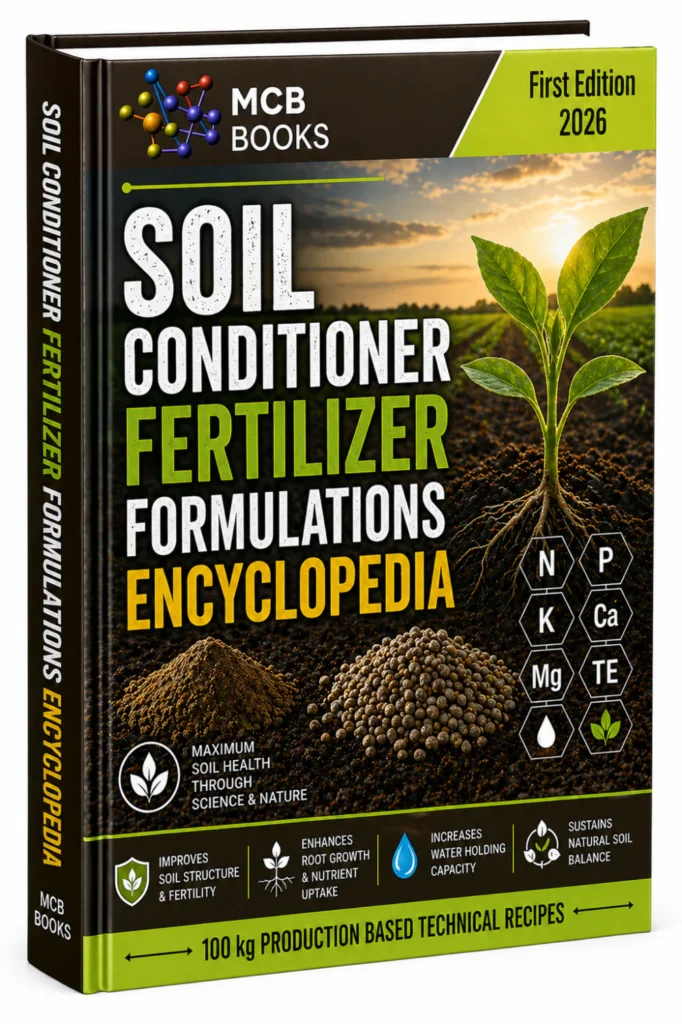
The commercial soil conditioner market continues to attract fertilizer manufacturers, agricultural input companies and entrepreneurs looking to develop products for soil improvement and professional crop production. However, producing a reliable soil conditioner requires more than selecting a few raw materials and mixing them together. Successful commercial soil conditioner production depends on formulation design, raw material […]

ORGANIC AND MINERAL SOIL CONDITIONER FERTILIZER PRODUCTION METHODS: MIXING, GRANULATION, pH CONTROL AND STABILITY

The production of organic and mineral soil conditioner fertilizers requires careful control of formulation, raw material compatibility and manufacturing conditions. Unlike simple fertilizer blends, soil conditioners may contain a combination of humic substances, organic matter, mineral components, calcium sources, gypsum, biochar, micronutrients and functional additives. For this reason, manufacturers must select the correct production method […]

SOIL CONDITIONERS FOR SALINE, ALKALINE AND DEGRADED SOILS: FORMULATIONS AND APPLICATION METHODS

Saline, alkaline and degraded soils can create serious limitations for agricultural production by restricting root development, reducing nutrient availability and negatively affecting soil structure. Excess salts, high sodium levels, unfavorable pH conditions, low organic matter and poor water infiltration can gradually reduce soil productivity. For these reasons, specialized soil conditioner formulations for saline, alkaline and […]

SOIL CONDITIONER FERTILIZER FORMULATIONS FOR IMPROVING SOIL STRUCTURE, WATER RETENTION AND ROOT DEVELOPMENT

Healthy soil structure is essential for efficient root growth, water movement, nutrient availability and long-term agricultural productivity. Compacted soils, low organic matter, poor aggregation and limited water-holding capacity can restrict plant development and reduce fertilizer efficiency. For this reason, soil conditioner fertilizer formulations are increasingly developed to improve the physical and chemical properties of the […]

HUMIC ACID, FULVIC ACID, GYPSUM AND BIOCHAR IN SOIL CONDITIONER FERTILIZER FORMULATIONS

Modern soil conditioner fertilizer formulations are designed to improve soil properties while supporting healthier root-zone conditions and more efficient agricultural production. Among the most widely used raw materials in these products are humic acid, fulvic acid, gypsum and biochar. Each material performs a different function, and when selected and formulated correctly, they can be used […]

RAW MATERIALS USED IN SOIL CONDITIONER FERTILIZER FORMULATIONS AND THEIR FUNCTIONS

The performance of a soil conditioner fertilizer depends heavily on the selection, quality and compatibility of the raw materials used in the formulation. Different ingredients perform different technical functions, such as improving soil structure, increasing organic matter, supporting nutrient availability, enhancing water retention and creating better conditions for root development. Understanding the role of each […]

HOW TO MANUFACTURE SOIL CONDITIONER FERTILIZERS FOR COMMERCIAL AGRICULTURAL PRODUCTION

The commercial production of soil conditioner fertilizers requires a combination of correct raw material selection, formulation knowledge, controlled manufacturing procedures and consistent quality standards. Soil conditioners are developed to improve the physical, chemical and biological characteristics of agricultural soils and may be produced in liquid, suspension, powder or granular forms. For manufacturers entering this market, […]

SOIL CONDITIONER FERTILIZER FORMULATIONS ENCYCLOPEDIA: COMPLETE GUIDE TO SOIL CONDITIONER PRODUCTION

Soil quality is one of the most important factors affecting plant growth, nutrient availability, root development and agricultural productivity. Intensive cultivation, salinity, low organic matter, poor soil structure and improper irrigation can gradually reduce soil performance. For this reason, soil conditioner fertilizers are widely used in modern agriculture to improve the physical, chemical and biological […]

GYPSUM TO PLANTS..RESULTS…USING

Overview of Gypsum in Plant Nutrition Gypsum is a naturally occurring mineral widely used in agriculture to improve soil conditions and support plant nutrition. It is a valuable source of calcium and sulfur, two essential secondary nutrients required for healthy plant growth and development. Unlike lime, gypsum does not significantly alter soil pH, making it […]