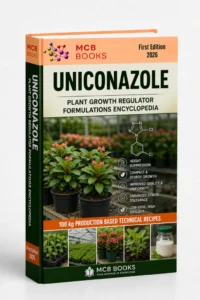
 Uniconazole is a plant growth regulator widely used in agriculture, horticulture and ornamental crop production for controlling excessive vegetative growth and improving plant architecture. It belongs to the triazole group of plant growth regulators and primarily acts by inhibiting gibberellin biosynthesis within the plant. By reducing excessive stem elongation, uniconazole can help produce shorter internodes, more compact plants and stronger growth structures. The UNICONAZOLE PLANT GROWTH REGULATOR FORMULATIONS ENCYCLOPEDIA provides practical technical information about formulation development, raw materials, manufacturing methods, agricultural applications and commercial production of uniconazole-based products.
Uniconazole formulations can be prepared in several product forms depending on the active ingredient concentration, crop requirements and intended application method. Common formulation concepts may include emulsifiable concentrates, suspension concentrates, soluble or dispersible liquid formulations and other specialized agricultural delivery systems. Developing a stable formulation requires careful selection of solvents, surfactants, emulsifiers, dispersing agents, wetting agents, stabilizers, preservatives and pH regulators. Each component must be compatible with the active ingredient and help maintain physical and chemical stability during storage and application.
One of the principal agricultural uses of uniconazole is plant height management. By reducing internode elongation, it can contribute to compact growth and improved canopy structure. These properties make uniconazole particularly relevant in ornamental plants, nursery production, greenhouse crops and certain commercial agricultural systems where excessive vegetative growth may reduce crop management efficiency. Depending on crop type and registered use, uniconazole may also influence flowering, fruit development, branching and overall plant growth balance.
The UNICONAZOLE PLANT GROWTH REGULATOR FORMULATIONS ENCYCLOPEDIA focuses not only on formulation composition but also on practical commercial manufacturing procedures. Important production stages may include raw material preparation, active ingredient dissolution or dispersion, controlled mixing, emulsification or homogenization, pH adjustment, viscosity control, filtration and final packaging. Correct manufacturing procedures are essential for achieving uniform active ingredient distribution and reliable product performance.
Quality control is another major factor in commercial uniconazole production. Manufacturers may evaluate parameters such as active ingredient concentration, appearance, pH, density, viscosity, emulsion stability, suspension stability, dispersibility and accelerated storage stability. These controls help ensure batch-to-batch consistency and improve product shelf life.
Application rates and methods must always be selected according to crop species, plant development stage, formulation strength and applicable local regulations. Because plant growth regulators can produce strong physiological responses at relatively low concentrations, precise dosage and uniform application are particularly important.
For formulators, agricultural manufacturers, researchers and product development professionals, the UNICONAZOLE PLANT GROWTH REGULATOR FORMULATIONS ENCYCLOPEDIA offers a structured technical reference covering formulation principles, manufacturing techniques, raw material selection, quality control and practical agricultural applications. It supports the development of stable, effective and commercially viable uniconazole plant growth regulator products.