INTRODUCTION
Glutaraldehyde-based disinfectants are widely used in hospitals, laboratories, and medical facilities for the high-level disinfection of surgical instruments. These formulations are highly effective against bacteria, viruses, fungi, and spores, making them essential in sterilization protocols where thermal sterilization is not suitable.
Due to their strong antimicrobial activity and compatibility with delicate instruments, glutaraldehyde disinfectants play a critical role in infection control systems worldwide.
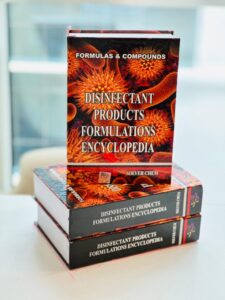
These formulations are part of the Disinfectant Products Formulations Encyclopedia, developed by a chemical engineer with over 40 years of industrial experience.
WHAT IS GLUTARALDEHYDE DISINFECTANT?
Glutaraldehyde is a potent dialdehyde compound used as a high-level disinfectant and sterilizing agent. It works by cross-linking microbial proteins, effectively inactivating microorganisms at the cellular level.
These disinfectants are commonly used for:
- Surgical instruments
- Endoscopes
- Dental tools
- Medical devices
- Laboratory equipment
KEY INGREDIENTS IN GLUTARALDEHYDE DISINFECTANT FORMULATIONS
A typical glutaraldehyde disinfectant formulation includes several functional components.
Glutaraldehyde (20–50%) acts as the primary active ingredient responsible for antimicrobial activity.
Buffering agents such as sodium bicarbonate or phosphate buffers stabilize the pH and enhance efficacy.
Surfactants improve wetting and penetration, ensuring full surface contact.
Corrosion inhibitors protect metal instruments from damage.
Water serves as the main solvent and carrier.
Optional additives may include:
- Chelating agents (EDTA)
- Fragrance (for odor masking)
- Color indicators
- Stabilizers
TYPICAL FORMULATION STRUCTURE (INDUSTRIAL OVERVIEW)
A standard industrial formulation may follow this structure:
- Glutaraldehyde solution: 10–25%
- Buffer system: 1–3%
- Surfactant: 0.5–2%
- Corrosion inhibitor: 0.2–1%
- Water: balance
The formulation must maintain a controlled pH (typically 7–8.5) to ensure maximum antimicrobial efficiency.
PRODUCTION PROCESS
The production of glutaraldehyde disinfectant solutions requires controlled mixing conditions to ensure stability and performance.
Water is first added into a stainless steel mixing tank. Buffering agents are dissolved completely under moderate agitation. The pH is carefully adjusted before adding glutaraldehyde solution.
Once the base solution is stabilized, surfactants are introduced slowly to avoid excessive foaming. Corrosion inhibitors and optional additives are then incorporated.
The mixture is stirred until fully homogeneous. Final pH adjustment is performed if necessary. The product is filtered and transferred into storage or filling units.
Strict safety measures must be applied due to the toxicity of glutaraldehyde vapors.
APPLICATION AREAS
Glutaraldehyde disinfectants are used in:
- Hospitals and surgical centers
- Dental clinics
- Veterinary facilities
- Pharmaceutical production units
- Laboratories
They are particularly suitable for heat-sensitive medical instruments.
ADVANTAGES OF GLUTARALDEHYDE DISINFECTANTS
- High-level disinfection capability
- Broad-spectrum antimicrobial activity
- Effective against spores
- Suitable for delicate equipment
- Long-lasting activity
LIMITATIONS AND SAFETY CONSIDERATIONS
Despite its effectiveness, glutaraldehyde must be handled carefully.
- Toxic vapors may cause irritation
- Requires proper ventilation
- Contact time must be controlled
- Residue rinsing is necessary
Operators should always use protective equipment.
SUMMARY
Glutaraldehyde disinfectants remain one of the most powerful solutions for surgical instrument sterilization. With proper formulation, controlled production, and safe handling, these disinfectants provide reliable and effective microbial control in medical environments.
Industrial formulations combine active ingredients, stabilizers, and performance additives to deliver consistent and high-level disinfection results.
RELATED ARTICLES
 Alcohol-Based Disinfectant Formulations Benzalkonium Chloride Disinfectant Formulation Hydrogen Peroxide Disinfectant Production Surface Disinfectant Formulations